Home › Blog › Emerging Tech & IT Trends
Top 5 SaaS Companies in the World in 2023
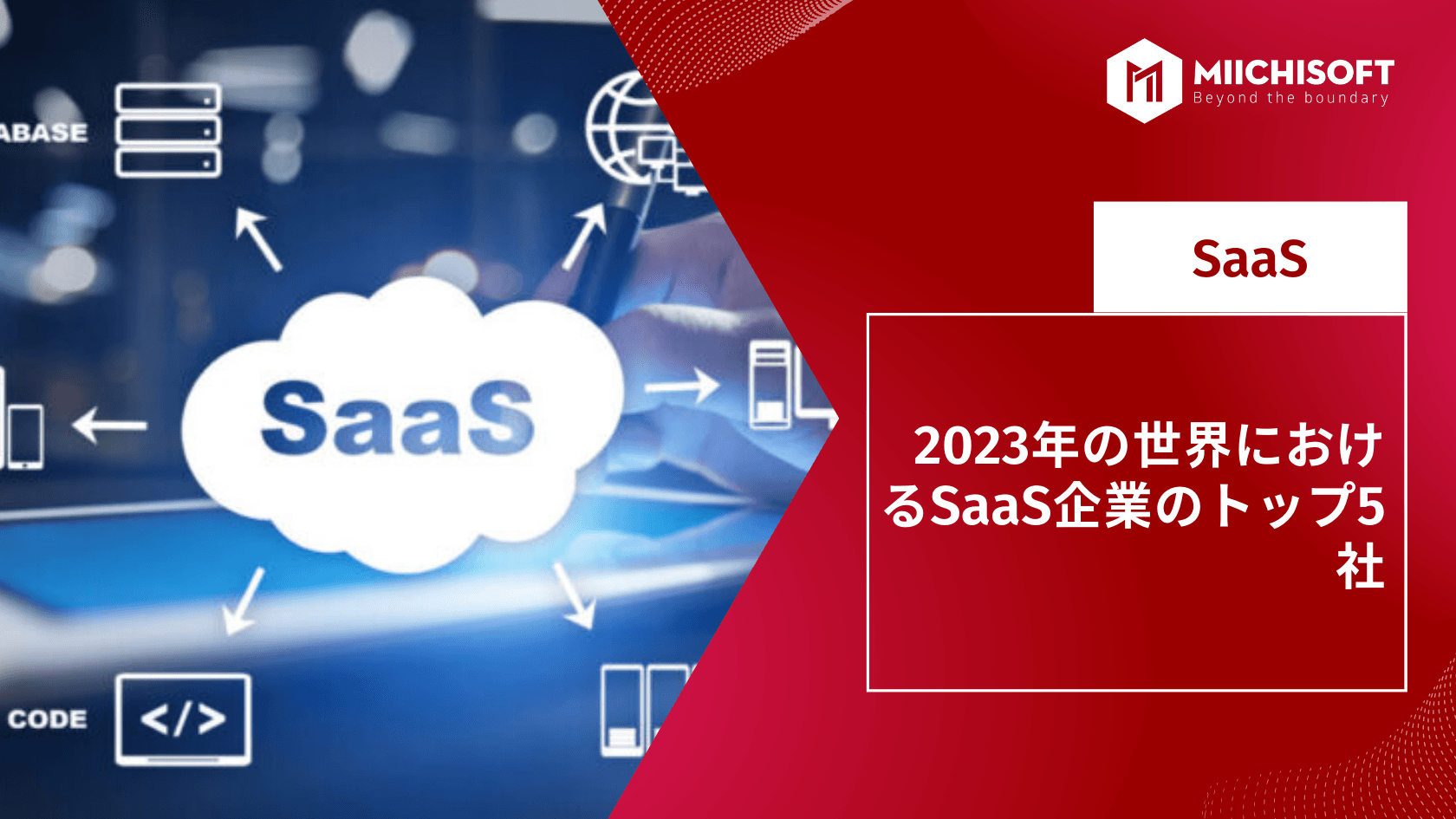
SaaS emerged 10 years ago as a new business model and has since become one of the most common ways to obtain software. Since the benefits and efficiency of SaaS platforms became clear, this model has been widely adopted by companies across ordinary business industries such as retail, banking, marketing, and healthcare.
This article explains the top 5 cloud service providers in the world in 2023.
1. What Is Software as a Service (SaaS)
Software as a Service is a software delivery model in which cloud-based software applications are licensed to users. Because applications are accessed over the internet, users don’t need to install or maintain the software locally.
Since the application itself runs on the SaaS provider’s servers, the provider takes responsibility for security, performance, and maintenance.
SaaS applications are typically licensed on a subscription basis. You pay a monthly fee depending on the level of service and the number of users you need. In this way, the SaaS provider delivers and maintains the application for customers over the internet, as a service.
2. Benefits of SaaS
The Software as a Service business model is an intriguing alternative to standard software installation. End users can benefit from a variety of advantages this solution offers. Here are some examples.
2.1 Cost
With the Software as a Service business model, end users pay a monthly subscription. This lets end users avoid the costs of implementing the application themselves. What’s more, since Software as a Service pricing models depend on usage level and can include service and support costs, companies don’t need to assign these tasks to their IT department.
2.2 Access to Advanced Applications
Customers can access powerful tools without having to install, update, or maintain them.
2.3 Time Savings
Applications are ready to use right away. They’re also designed with ease of use in mind, so users can focus on the task at hand instead of wrestling with the application.
2.4 Always Up to Date
End users don’t need to worry about updates or legacy software — that’s automatically taken care of as part of the Software as a Service solution.
2.5 Access Applications From Anywhere
Since all data is stored in the cloud, employees can access applications from any internet-connected device, making it an ideal solution for remote work. And even if hardware fails, no data is lost.
2.6 Security
SaaS services are delivered through secure IT systems capable of meeting the needs of even the most demanding customers.
2.7 Flexibility
SaaS packages are scalable and can easily be adjusted (in either direction) as your company or demand grows. All you need to do is upgrade your existing plan or subscription. This is especially useful for companies with strong seasonal trends, letting them flexibly reduce subscription costs when needed.
2.8 Availability
SaaS applications are designed to be available at all times. Vendors maintain a high level of reliability by protecting business continuity even in the event of a natural disaster.
Software as a service has been a great development for small and medium-sized businesses (SMBs), letting them focus on growing their business. Many SMBs also have very limited time, resources, and expertise. That’s why the cost, security, and ease of use of SaaS bring them major benefits.
Reference: SaaS Development: How to Develop a SaaS Application
3. Top 5 Cloud Service Providers in the World in 2023
3.1 Amazon Web Services (AWS)

Amazon Web Services (AWS), Amazon.com’s cloud computing service, is the world’s largest cloud service provider. From its data centers, it offers more than 200 full-featured services, including compute, storage, and databases.
AWS currently operates 26 regions and 84 availability zones. These regions and availability zones are located across the US, AWS GovCloud (US), the Americas, Europe, Asia Pacific, and the Middle East and Africa.
Source: Dgtl Infra
Amazon Web Services (AWS) grew its net sales from $8 billion in 2015 to over $17 billion in 2017, reaching $35 billion in 2019, and now generates close to $74 billion in revenue on an annualized basis.
This remarkable growth stems from AWS expanding from 32 availability zones in 2015 to 52 availability zones in 2017, and now reaching 84 availability zones. Alongside this, the company has launched thousands of new AWS services, further fueling its expansion.
3.2 Microsoft Azure

Microsoft Corporation’s Intelligent Cloud segment includes Azure, the world’s second-largest cloud service provider. Through Microsoft Azure, it offers a consistent hybrid cloud experience, developer productivity, artificial intelligence (AI) capabilities, and security and compliance.
Microsoft Azure currently operates 60 regions and 116 availability zones. These regions and availability zones are distributed across the US, Azure Government (US), the Americas, Europe, Asia Pacific, and the Middle East and Africa.
Source: Dgtl Infra
Microsoft Azure has more than 200 data centers around the world, each equipped with computer servers backed by independent power, cooling, and networking. This data center infrastructure is connected by more than 175,000 miles of fiber lines across 140 countries.
Microsoft’s cloud revenue — which includes Azure and other cloud services, Office 365 Commercial, the commercial portion of LinkedIn, and Dynamics 365 — reached $23.4 billion in the most recent quarter, up 32% year-over-year.
On an annualized basis, this puts Microsoft Cloud’s revenue at $93.6 billion. However, since Microsoft doesn’t explicitly disclose Azure’s revenue, Azure represents only a subset of Microsoft Cloud’s total revenue.
3.3 Google Cloud Platform (GCP)

Google Cloud Platform (GCP), part of Alphabet Inc., is the world’s third-largest cloud service provider, offering enterprise-grade cloud services. GCP lets developers build, test, and deploy applications on distributed, scalable infrastructure while leveraging services such as security, data management, analytics, and artificial intelligence (AI).
Google Cloud currently operates 34 regions and 103 availability zones. These regions and availability zones are located across the US, the Americas, Europe, and Asia Pacific.
Source: Dgtl Infra
Alphabet Inc.’s Google Cloud segment earns revenue from fees charged for infrastructure, platform, and other services. In its most recent quarter, Google Cloud generated $5.8 billion in revenue, up about 44% year-over-year. On an annualized basis, this puts Google Cloud’s revenue at $23.3 billion.
3.4 Alibaba Cloud

Alibaba Group’s cloud computing division, known as Alibaba Cloud, is the world’s fourth-largest cloud service provider, a leading cloud vendor in the Asia-Pacific region, and China’s largest cloud service provider. Through Alibaba Cloud, it offers cloud services such as elastic computing, databases, storage, network virtualization, large-scale computing, security, management and application services, big data analytics, and machine learning.
Source: Dgtl Infra
Alibaba Cloud currently operates 27 regions and 84 availability zones. Within mainland China, Alibaba is the overwhelmingly dominant cloud service provider, with more than 10 regions deployed nationwide. Outside mainland China, Alibaba Cloud operates in the US, Europe, the Asia-Pacific region, and the Middle East.
Alibaba Group earns cloud computing revenue mainly from enterprise customers, based on their usage period and level of usage. The company’s cloud segment generated $2.99 billion (RMB 18.971 billion) in revenue in its most recent quarter, up 12% year-over-year. On an annualized basis, this puts Alibaba Cloud’s revenue at close to $12 billion.
3.5 Oracle Cloud
Oracle Corporation’s cloud services include Oracle Cloud Software-as-a-Service (SaaS) and Oracle Cloud Infrastructure (OCI). Through OCI, the company acts as a cloud service provider, offering infrastructure technology such as compute, storage, and networking services on an as-a-service basis.
Oracle Cloud currently operates 38 regions and 46 availability zones. These regions and availability zones are located across the US, Canada, Europe, the Middle East and Africa (EMEA), Latin America, and Asia Pacific. Oracle Cloud also offers dedicated government cloud regions for the US government, the US Department of Defense (DoD), and the UK government.
Source: Dgtl Infra
Oracle Cloud Infrastructure (OCI) typically bills customers upfront, with fees gradually declining as OCI services are consumed by the customer over a set period. In the most recent quarter, Oracle’s cloud revenue, including IaaS and SaaS, reached $2.9 billion, up 19% year-over-year. On an annualized basis, this puts Oracle Cloud’s revenue at $11.6 billion.
4. Frequently Asked Questions About SaaS
4.1 Common Benefits of Cloud and SaaS
Cloud and SaaS share the following common benefits.① No lengthy installation required. Because everything lives in the cloud, there’s no need to run drivers, and every update happens instantly. What’s more, since the cloud is usually hosted rather than owned, it’s the third party’s job to keep everything running smoothly and up to date — so you’ll rarely notice any downtime on your end.② You can share and sync data across your whole network much faster. Everything from code updates to business emails can be shared and worked on together in real time.③ It’s far more cost-effective than on-premises. Storing some or all of your infrastructure in the cloud is often the most efficient way to manage company data.④ Better redundancy helps prevent data loss and downtime. In a cloud environment, you can easily add extra layers of redundancy, helping guard against failures or complete data loss.⑤ Greater security. Combining public and private cloud puts important security safeguards in place.
4.2 Examples of SaaS Applications
Examples of SaaS-type applications include Google G-Suite, Office 365, Salesforce, Cisco Webex, and Zendesk.
4.3 What Are the Top 12 SaaS Trends for 2023?
① Artificial intelligence② Machine learning③ Prioritizing SaaS security ④ Vertical SaaS⑤ Data as a Service (DaaS)⑥ Growing need for API connectivity⑦ Shift toward PaaS⑧ Focus on retention and churn⑨ Consolidation of the SaaS market ⑩ Rise of even more SaaS super-apps ⑪ Centralizing analytics⑫ Low-code capabilities
Miichisoft Co., Ltd. – A SaaS Service Provider in Vietnam
Miichisoft aims to be more than just an outsourcing company — we strive to be a true “technology partner,” supporting clients from turning an idea into reality all the way through to maintaining the project.
Alongside the evolution of SaaS, we’ve partnered with Japanese companies to develop SaaS services and systems mainly for industries such as real estate, e-commerce, logistics, e-learning, and construction.
What sets Miichisoft apart from other SaaS competitors comes down to two points: our pricing and speed, and the fact that having a base in Japan lets us talk directly with customers.
If you’re considering a SaaS service going forward, please feel free to reach out to us.
Thank you very much.
Company Overview
Founded | April 2018 |
Representative | VU HONG CONG |
Number of employees | 185 (as of 2023/03) |
Business activities | Offshore development, SaaS service lab development, IT consulting, Blockchain development, VR/AR development |
Related Articles
AI News Flash | Google Integrates Gemini into Chrome

Top 3 Workflow Automation Platforms: Is n8n, Dify AI, or Make the Right Fit for Your Business?
AI News Flash | xAI Officially Unveils Its Most Powerful Multimodal Model, "Grok 4.0"
AI News Flash | Gemini AI's Android Integration Expands, Turned On by Default Regardless of User Settings
AI News Flash | ChatGPT Is Evolving From a "Q&A AI" Into a "Multifunctional Work Partner"