Home › Blog › Emerging Tech & IT Trends
What Is XR? Explaining the Difference Between XR (AR/VR/MR) and the Metaverse
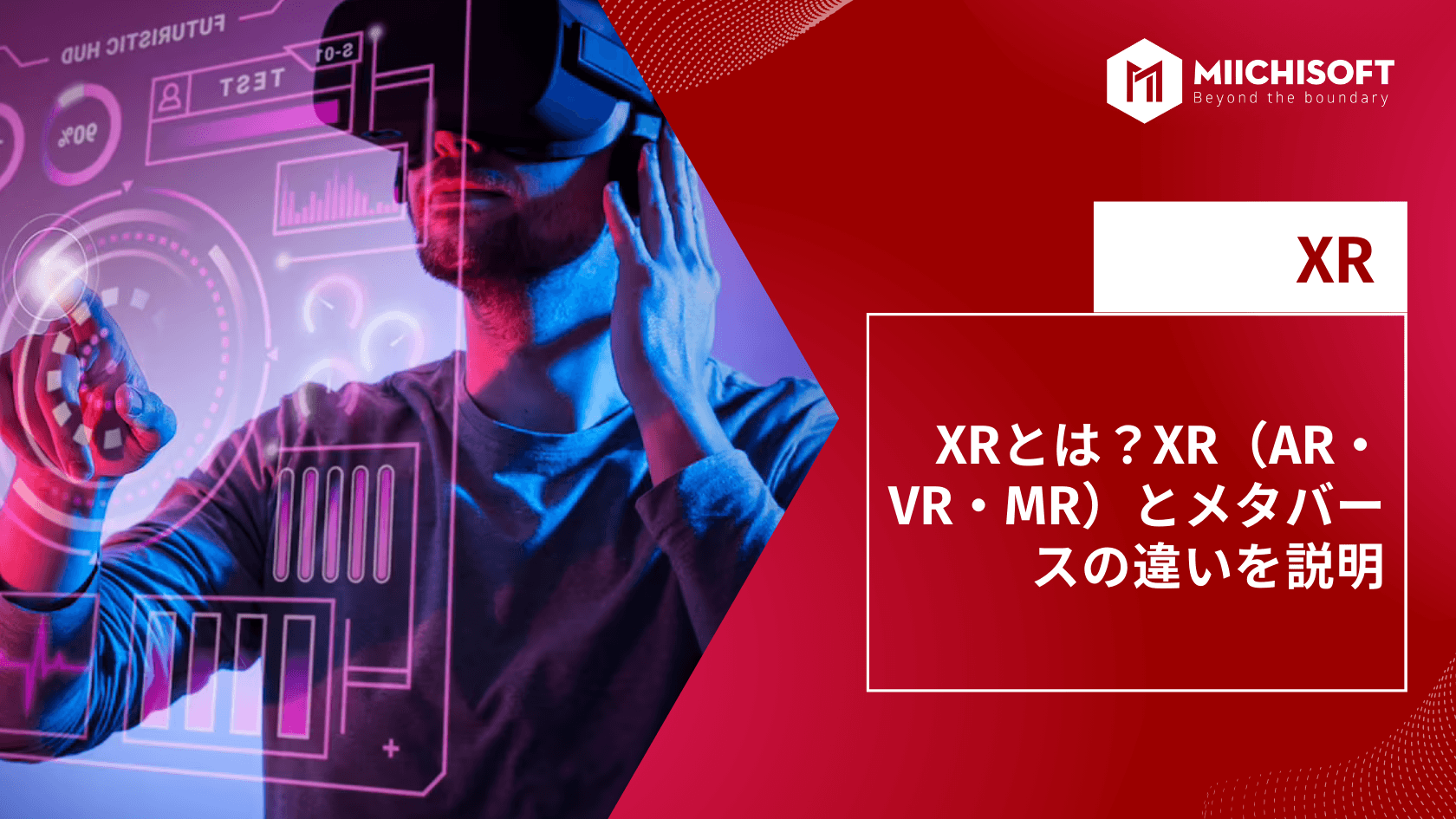
If you've heard of immersive video games, virtual travel, or AR shopping, you've probably come across terms like AR (Augmented Reality), VR (Virtual Reality), MR (Mixed Reality), and XR (Extended Reality).
This article explains in detail what these terms mean and how they differ, so you can clearly see which one is right for you.
Table of Contents:
- 1. What Is XR (AR/VR/MR)?
- 2. Comparing AR, VR, and MR
- 3. XR vs. Metaverse: What's the Difference?
- 4. Future Trends in XR
- 5. Summary
1. What Is XR (AR/VR/MR)?
XR (Extended Reality) is an umbrella term for technologies related to expanded perception, including Augmented Reality (AR), Virtual Reality (VR), and Mixed Reality (MR).
- Virtual Reality (VR) is a technology that recreates a fully virtual environment, letting users experience and interact with games, applications, and digital content within a virtual space.
- Augmented Reality (AR) is a technology that overlays virtual information onto the real environment. Users can see and interact with virtual objects displayed on top of their actual surroundings.
- Mixed Reality (MR) combines virtual reality and augmented reality, creating a new environment where virtual objects and the real environment interact with each other.
XR is widely used across many fields, including entertainment, training, healthcare, and architecture. XR technology delivers impressive experiences and is opening up new creative possibilities.
▼ If you'd like to learn more about "Augmented Reality (AR) and Virtual Reality (VR)," please also see this article.
A Thorough Comparison of AR (Augmented Reality) and VR (Virtual Reality)
2. Comparing AR, VR, and MR
Extended reality is an umbrella term that broadly covers the group of technologies made up of augmented reality, virtual reality, and mixed reality. For example, a virtual reality headset and an augmented reality headset are different devices, but both are treated as extended reality technology.

These perception-altering technologies deal with virtual elements, meaning the device's built-in computer generates every object you see.
With VR, CGI completely covers your field of view, so you're fully immersed in an entirely fake world. AR and MR also use CG, but since the goal is to let you see your surroundings, the CG never covers your entire field of view. Instead, the physical environment is enhanced or altered in some way.
Some AR and MR experiences can be enjoyed on an ordinary smartphone without any headgear, but VR always requires a headset.
2.1. Technology: VR blocks your view, AR/MR don't

Before diving deeper into these XR technologies, we first need to clearly distinguish how each of them works. We've covered this in detail in the linked article above, but for now, there's one key fact that separates AR and MR from VR: VR completely blocks your view of the real world.
Virtual reality is built to hide everything except the CG imagery. Augmented reality and mixed reality, on the other hand, are built to show you both the real world and the virtual world.
As we'll explain later, this is because AR and MR are designed to enhance and alter what you're already doing and seeing around you, while VR is designed to replace reality entirely with something fake.
2.2 Immersion: VR is the clear winner, MR is close behind

That said, if you think of "immersion" as simply a perceptual shift where "the environment feels different from usual," then MR — with its interaction between virtual and real elements that AR lacks — comes close to matching it.
Mixed reality objects can be anchored to a fixed position in real space.
That means you can physically walk around them and interact with them as if they were real — building a solid bridge between a fully real environment and a fully virtual one.
2.3. Use cases: VR/MR in education, VR in entertainment

All three types of XR have many applications, and many of those applications overlap with the other XR types.
For example, you can overlay a hospitalized patient's vitals or detailed X-ray images onto their body for precise surgery. MR isn't especially useful in that kind of scenario — it's more valuable for using virtual objects to "rehearse" a surgery.
What's more relevant to the general public, without a doubt, is entertainment and gaming.
AR, VR, and MR each create enjoyable experiences in their own way, but only virtual reality delivers the deepest level of immersion.
With VR, you can build an entire movie theater just for yourself, and realistic FPS games or virtual tourism are best enjoyed wearing a headset, undisturbed by the outside world.
AR and MR make it possible to overlay reality with a variety of useful functions — trying on clothes virtually, checking whether furniture will fit a room, or seeing customer reviews layered over products in a store — and can dramatically change the way we shop. With VR, meanwhile, simply putting on a headset lets you fully simulate and browse an entire shopping mall.
3. XR vs. Metaverse: What's the Difference?
While XR (AR, VR, MR) is a set of technologies that enable immersive experiences and interaction within a virtual environment, the metaverse is a concept representing a fully immersive, interconnected virtual world that merges the physical and digital worlds. Here are the key differences between XR and the metaverse.

Overall, while XR technology provides immersion within a specific virtual environment, the metaverse is a much larger concept, envisioning a fully interconnected, persistent virtual world that enables seamless interaction between users and virtual objects.
4. Future Trends in XR
Extended reality (XR) — encompassing augmented reality (AR), virtual reality (VR), and mixed reality (MR) — is a rapidly evolving field. Here are some of the future trends in XR:
- Growing adoption: XR technology is becoming more accessible and affordable, and it's increasingly being adopted across industries such as education, healthcare, and entertainment.
- Convergence with AI: XR technology is increasingly converging with artificial intelligence (AI) — for example, using AI-powered voice assistants in AR and VR applications — to deliver more personalized, intelligent experiences.
- Hardware improvements: The development of lightweight, high-resolution displays lets users enjoy more immersive experiences. On top of that, advances in haptic feedback technology are making XR experiences feel more realistic and engaging.
- Social XR: Social XR refers to the convergence of XR technology with social media platforms, allowing users to interact with each other in a virtual space. This trend is expected to grow in popularity as more people seek immersive social experiences.
- XR for training and education: XR technology is being used to deliver immersive training and education experiences, such as virtual simulations for medical training and immersive language-learning programs.
- XR in commerce: XR technology is being used to enhance the e-commerce experience, such as letting customers virtually try on clothes or furniture before buying.
Overall, XR technology is expected to keep evolving, expand into new industries, and deliver ever more immersive and engaging experiences to users.
5. Summary
All three of these extended reality technologies are useful, and which one you should choose depends heavily on what you're trying to achieve.
AR and MR are both built around blending reality with imagination, but MR has the edge by pushing that blend of reality further.
VR can't show you the real world, but it excels by fully immersing you in a digital reality that you can enjoy alone or with friends.
If you're after escapism or a rich, realistic, game-like experience, VR is essential.
MR is almost synonymous with AR, but it has the advantage of feeling more realistic than augmented reality, since you can interact with virtual elements that stay anchored in place no matter how you look at them.
AR, however, is more ubiquitous, since it's available in some form on nearly every modern smartphone, and is often free to use.
Related Articles
AI News Flash | Google Integrates Gemini into Chrome

Top 3 Workflow Automation Platforms: Is n8n, Dify AI, or Make the Right Fit for Your Business?
AI News Flash | xAI Officially Unveils Its Most Powerful Multimodal Model, "Grok 4.0"
AI News Flash | Gemini AI's Android Integration Expands, Turned On by Default Regardless of User Settings

AI News Flash | ChatGPT Is Evolving From a "Q&A AI" Into a "Multifunctional Work Partner"