Home › Blog › Emerging Tech & IT Trends
How to Implement AR in Facility Management: Applications and Use Cases

Augmented Reality (AR) is being used as an innovative technology in facility management. By overlaying digital information onto the physical environment, AR delivers information in real time and improves the user experience. Below, we explain in detail the various benefits and applications AR brings to facility management.
1. Fundamentals of Augmented Reality
Augmented Reality (AR) is a technology that overlays computer-generated information and virtual objects onto the real-world environment. Through devices such as smartphones, tablets, and AR headsets, AR extends the real world and provides users with rich information and experiences.
The basic elements of AR include the following.
1.1. Sensors and Tracking
AR devices are equipped with sensors (such as accelerometers, gyroscopes, and magnetometers) that track position, orientation, and movement. This allows the device to understand the user's viewpoint and location and display the appropriate information or virtual objects.
1.2. Display
The display of an AR device combines the view of the real world with virtual objects. Some AR devices also deliver the AR experience through the screen of a smartphone or tablet.
1.3. Computer Graphics
AR uses computer graphics to composite virtual objects and information onto the real world. This lets users see an additional visual layer over their real-world environment.
1.4. Sensing and Recognition
AR devices have the ability to recognize and interpret their surrounding environment. This enables the device to detect objects and planes, recognize faces, and recognize markers, allowing for accurate alignment and object placement.
AR has a wide range of applications. Below are some common use cases of AR:
- User assistance: Used to support users' daily life and work, such as navigation, guidance, and displaying real-world information.
- Education and training: AR is used in education and training programs at schools and educational institutions, providing real-time visual experiences and interactive learning.
- Marketing and advertising: AR is used for product and service presentations, virtual try-ons, and interactive advertising campaigns.
- Entertainment: AR is incorporated into games and entertainment content, offering new experiences that blend the real and virtual worlds.
AR is rapidly evolving with technological advances, creating innovative solutions across various fields such as business, education, healthcare, and entertainment. Going forward, AR's range of applications is expected to keep expanding and bring an even greater impact to our daily lives.
2. Benefits of AR in Facility Management
Augmented Reality (AR) brings various benefits to facility management. Below, we explain the main benefits AR provides for facility management.
2.1. Visualization and Digital Twin Creation
AR is useful for visualizing facilities and creating digital twins. Using AR, an actual facility can be mapped into a digital space to retrieve information in real time. This makes it possible to visualize the facility's structure, equipment layout, and wiring, and to create a digital twin.
2.2. Streamlining Maintenance and Troubleshooting
AR helps streamline maintenance work and troubleshooting. Using AR, maintenance staff can display information related to actual equipment and facilities in real time. AR shows inspection and work procedures, and helps identify required parts, tools, and fault locations. This improves the efficiency and accuracy of maintenance work and minimizes downtime.
2.3. Enhancing Training and Skill Development
AR is also useful for training and skill development in facility management. Using AR, employees can receive hands-on training in a virtual environment. For example, they can virtually experience equipment operating procedures and safety procedures. AR also provides real-time feedback, helping employees acquire skills and improving the quality and efficiency of their work.
2.4. Space Planning and Design Support
AR is useful for supporting facility space planning and design. Using AR, facility managers can overlay digital models onto the physical space for display.
3. Specific Use Cases of AR in Facility Management

Here are some specific use cases of Augmented Reality (AR) in facility management.
3.1. Maintenance and Repair Support

Cre: Alamy
As a specific use case of AR in facility management, there is maintenance and repair support like the following.
① Visualization of maintenance procedures
② Parts identification and replacement guides
③ Real-time support and remote troubleshooting
④ Data logging and history management
Through these specific use cases, AR supports maintenance and repair work in facility management and improves efficiency and accuracy.
3.2. Indoor Navigation and Wayfinding
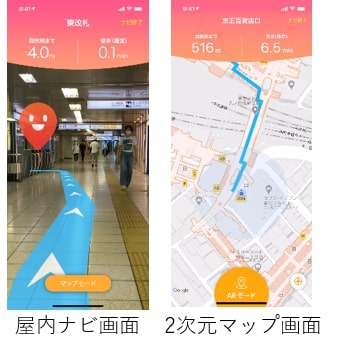
Cre: PR TIMES
AR can support navigation and wayfinding within large-scale facilities. By using AR to provide real-time route guidance and display points of interest, employees and visitors can reach their destination without getting lost.
3.3. Space Planning and Layout Optimization

Cre: Hikkoshi Renrakucho
AR can be used for space planning and layout optimization. By using AR to overlay virtual furniture and equipment onto the actual space, different layout options can be evaluated. This helps make more efficient use of space and improve work efficiency.
3.4. Safety Training and Simulation

Cre: Nikkan Kogyo Shimbun
AR can be used for safety training and simulation. By recreating virtual scenarios and environments with AR, realistic safety training can be provided to employees. This allows them to practically learn about dangerous situations and appropriate response methods.
3.5. Real-Time Data Visualization and Analysis

Cre: Analytics Insight
AR can be used to visualize and analyze real-time data within a facility. Data collected from sensors and devices can be displayed with AR, making it possible to monitor facility performance and energy efficiency. In addition, using data analysis tools combined with AR makes it possible to gain insights into future trends and improvements.
These are just some specific examples of AR applications, but AR holds the potential to bring various benefits to facility management. With technological advances, further application areas and evolution are expected.
4. Future Potential of AR in Facility Management
Augmented Reality (AR) holds very high future potential in facility management. Below, we introduce some points that AR is expected to bring in the future.
4.1. Real-Time Information Integration
Using AR makes it possible to integrate real-time information from various sensors and devices within a facility and grasp the facility's condition in real time. This makes it easier to optimize the facility's performance and energy efficiency.
4.2. Integration with IoT
Combining AR with the Internet of Things (IoT) strengthens coordination with devices and equipment within a facility. Through AR, it is possible to display sensor data, control devices, and show maintenance information.
4.3. Remote Support and Collaboration
Using AR makes remote support and collaboration possible. Experts and technicians can diagnose issues within a facility and provide solutions remotely via AR. Multiple stakeholders can also share the same AR environment to collaborate.
4.4. Convergence with AI
The convergence of AR and artificial intelligence (AI) strengthens functions such as automated facility monitoring and predictive maintenance. Through AR, AI can analyze data within a facility, detect anomalies, and suggest optimal maintenance schedules.
4.5. Interactive User Experience
AR provides a new means of enriching the user experience. By offering interactive guidance and information to visitors and users through AR, it becomes possible to provide a more engaging environment and service.
Through these elements, AR is expected to play an increasingly important role in facility management. As technology advances, AR's functions and application areas will expand further, delivering value in various ways, including improved efficiency and convenience and promoting sustainability.
Conclusion
With the evolution of AR and the advancement of technology, it is expected to bring benefits to various aspects of facility management. By leveraging AR, more effective facility management can be achieved, including improved efficiency, work accuracy, and skill development.
Related Articles

AI News Flash | Google Integrates Gemini into Chrome

Top 3 Workflow Automation Platforms: Is n8n, Dify AI, or Make the Right Fit for Your Business?

AI News Flash | xAI Officially Unveils Its Most Powerful Multimodal Model, "Grok 4.0"

AI News Flash | Gemini AI's Android Integration Expands, Turned On by Default Regardless of User Settings

AI News Flash | ChatGPT Is Evolving From a "Q&A AI" Into a "Multifunctional Work Partner"