Home › Blog › Emerging Tech & IT Trends
Introducing How AR Technology Is Implemented and Applied in the Energy Sector!
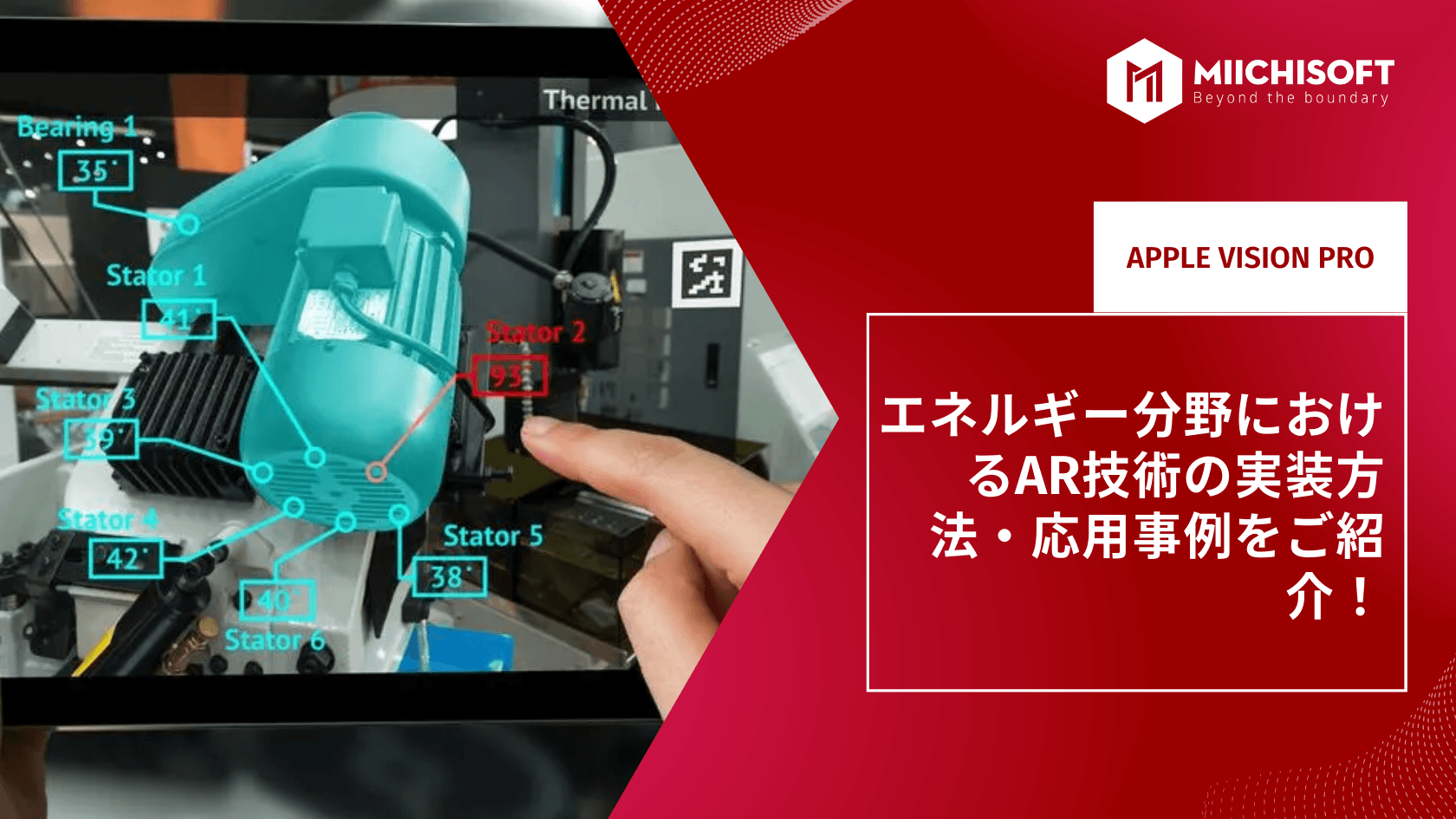
Augmented reality (AR) is a technology that can transform how the energy sector operates. By overlaying digital information onto the real world for immersive experiences, AR can strengthen energy production, distribution, and maintenance.
AR is already used across many industries, from gaming to healthcare and education. In energy too, AR can improve safety, boost efficiency, and cut costs.
▼ If you'd like to learn more about “XR (AR/VR/MR) and the Metaverse,” please also see this article.
What is XR? Explaining the difference between XR (AR/VR/MR) and the Metaverse
1. Benefits of Augmented Reality (AR) in the Energy Sector

The benefits of augmented reality (AR) in the energy sector are wide-ranging. Below we introduce some of them.
1.1 Visualization and Simulation
AR visually overlays energy infrastructure and processes onto the real world, making complex systems and equipment easier to understand. Combined with simulation, it can also predict behavior under various scenarios.
1.2. Real-Time Information Delivery
AR excels at delivering real-time information. Showing sensor and network data via AR lets users instantly grasp energy usage, efficiency, and fault locations, enabling fast decisions and problem-solving.
1.3. Improved Work Efficiency
AR lets workers carry out on-site tasks more efficiently. AR devices show work steps and instructions in real time, and can also help pinpoint faults and guide repairs.
1.4. Improved Safety
Workplace safety is a key challenge in the energy sector. AR gives workers warnings and guidance about hazards and potential risks, and lets them learn in advance, through training and simulation, how to respond to dangerous situations.
1.5. Enhanced Training and Education
AR is also valuable for training and education. Recreating real equipment and processes lets users gain hands-on experience in a virtual environment, helping beginners build skills and learn safe operating procedures.
1.6. Renewable Energy Adoption
Renewable energy adoption is a key step toward a sustainable energy future. AR lets users experientially understand its benefits and mechanisms: wind and solar equipment can be recreated in AR to visually show their effects and environmental impact.
AR's benefits in energy are wide-ranging — greater efficiency, improved safety, stronger training, and wider renewable energy adoption. Making the most of them should drive progress toward a sustainable energy future.
2. Use Cases of Augmented Reality (AR) in the Energy Sector

Cre: stantec
AR has a wide range of use cases in the energy sector. Below are some concrete examples.
2.1. Visualizing Energy Infrastructure
AR can visualize energy infrastructure in real time. For example, power grid or gas pipeline status can be shown on an AR device so workers can grasp infrastructure conditions, easing monitoring and fault detection and improving maintenance efficiency.
2.2. Work Procedure Guidance and Support
AR can show work steps and instructions to workers in real time, letting them check procedures and safety guidelines via an AR device as they work. For instance, when inspecting a wind turbine, inspection points and steps appear on the AR display, letting workers proceed faster and more accurately.
2.3. Fault Diagnosis and Repair Support
AR helps diagnose and repair faults efficiently. Equipment can be scanned with an AR device to pinpoint anomalies, and displaying repair steps or part-replacement guides lets workers repair quickly and accurately, shortening downtime and improving maintenance.
2.4. Energy Monitoring and Efficiency
AR can show users energy usage and efficiency in real time. For example, a building's energy usage and saving potential can be shown via an AR device, letting users see how to save energy. AR can also visualize energy flows and optimize systems to further improve efficiency.
2.5. Enhanced Training and Education
AR is also used for training and education. In energy-sector programs, AR provides hands-on experience — for example, wind farm operators can learn turbine operating procedures and safety precautions in a virtual environment, helping build skills and safe work methods.
These are just some use cases for AR in the energy sector. Because AR brings wide-ranging benefits — efficiency, safety, stronger training, and more — its adoption is expected to keep expanding.
3. The Future of Augmented Reality (AR) in the Energy Sector
The future potential of AR in the energy sector is very large. Below are a few key points.
3.1 Technological Evolution
AR technology keeps steadily advancing. Devices like head-mounted displays and smart glasses are shrinking while offering higher resolution and frame rates. Related sensor and tracking technology is also improving, enabling more accurate positioning and motion recognition — making AR more realistic and broadening its applications in energy.
3.2. Data Integration
The energy sector generates enormous amounts of data. AR can visually display real-time sensor and network data, making analysis and decisions easier. Integrating with data will enable more effective energy management, including optimized use and early problem detection.
3.3. Interactive Operation and Integration
AR emphasizes interaction with users. In the future, energy infrastructure could be controlled using gestures, voice recognition, and similar methods. AR is also increasingly integrating with other technologies — combining it with AI or blockchain, for instance, may enable automated energy networks and smart contracts.
3.4. Evolution of Training and Education
AR is bringing major evolution to training and education in the energy sector. Virtual training and simulation let workers and engineers gain more hands-on experience, expected to speed up skill acquisition and safer work procedures.
3.5. Contribution to Sustainable Energy
AR also supports renewable energy adoption and better efficiency. As users experientially understand renewable sources and energy management, interest in sustainability should grow. AR-based monitoring and efficiency methods can also help minimize energy use and loss.
AR's future in the energy sector rests on technological evolution, data integration, interactive operation, evolving training and education, and contributions to sustainability. These advances will drive major progress toward a more efficient, sustainable energy industry.
5. Summary
In conclusion, AR can revolutionize the energy sector by improving safety, boosting efficiency, and cutting costs. AR is still fairly new, but is already used across many industries and is expected to become a major player in energy within a few years. As the sector evolves and adapts to changing markets and technology, AR will undoubtedly play an important role in shaping the future of energy production, distribution, and consumption.
▼ If you'd like to learn more about “the difference between augmented reality (AR) and virtual reality (VR),” please also see this article.
A thorough comparison of augmented reality (AR) and virtual reality (VR)
Related Articles

AI News Flash | Google Integrates Gemini into Chrome

Top 3 Workflow Automation Platforms: Is n8n, Dify AI, or Make the Right Fit for Your Business?

AI News Flash | xAI Officially Unveils Its Most Powerful Multimodal Model, "Grok 4.0"

AI News Flash | Gemini AI's Android Integration Expands, Turned On by Default Regardless of User Settings

AI News Flash | ChatGPT Is Evolving From a "Q&A AI" Into a "Multifunctional Work Partner"