Home › Blog › Emerging Tech & IT Trends
AI News Flash | Perplexity Launches New "Labs" Service — Document Creation Gets More Versatile

Hello from the world of AI! In today's newsletter, we bring you the following top stories: ・Perplexity launches new "Labs" service — document creation gets more versatile ・Google quietly launches an app for running AI models directly on mobile devices ・Opera unveils "Neon," a next-gen browser that automates work with AI
PERPLEXITY
Perplexity Launches New "Labs" Service — Document Creation Gets More Versatile
AI search service Perplexity has rolled out a new feature called "Perplexity Labs" for Pro plan subscribers ($20 a month), letting them generate a range of deliverables such as reports, spreadsheets, and dashboards.The new feature is already available on web browsers, iOS, and Android, with dedicated Mac and Windows apps planned for the future.According to Perplexity's blog, "Perplexity Labs" is designed for use across both work and personal projects and can handle tasks that take 10 minutes or more. It also offers advanced capabilities such as automatically generating files or building simple apps.The launch lands around the same time AI startup Manus released a slide-creation feature, underscoring a trend of AI firms expanding beyond search. Perplexity also recently previewed its web browser "Comet" and acquired the professional social network "Read.vc."

Source: Perplexity Labs
What Perplexity Labs Can Actually Do
Built on AI, "Perplexity Labs" can handle a wide range of tasks, including: ・Data research and analysis, typically completed in about 10 minutes ・A wide array of tools — web search, code execution, and automatic chart/image generation ・Programming features for data formatting, implementing formulas, and generating documents ・Support for building interactive web appsEvery file produced is saved together in a dedicated tab, easy to view and download anytime.Perplexity says "this flexibility makes it possible to create whatever materials best suit a given project."That said, AI still has real limitations at this stage, so results won't always be perfect. Even so, it's a meaningful step forward that anyone can now use AI to easily produce useful output.
A Growing Focus on Enterprise Features
Perplexity has been steadily strengthening its enterprise features in recent years. Last summer, it launched an "Enterprise plan" with user management, internal knowledge search, and other advanced capabilities.This push reflects expectations from its VC backers. Perplexity is reportedly in talks to raise $1 billion at an $18 billion valuation.
Google Quietly Launches an App for Running AI Models Directly on Mobile Devices
Last week, Google quietly released "Google AI Edge Gallery," which lets users download open-source Hugging Face models straight to their phones and run them on-device.Available on Android first, with iOS planned, it lets users pick a model to generate images, answer questions, or write/fix code — fully offline, on-device.Cloud AI performs well, but concerns persist over data handling and internet dependence, hence interest in this on-device app.

Source: Google
An alpha version is on GitHub, downloadable by anyone who follows the setup steps. The home screen has shortcuts to key features like "Ask Image" and "AI Chat"; selecting a task lists available models, including Google's own "Gemma 3n."A "Prompt Lab" space lets users quickly tackle single tasks like summarizing or restructuring text, with ready-made prompts and customizable behavior.Performance varies by device: stronger phones run faster, though larger models can lag.Google is collecting developer feedback; it ships under the Apache 2.0 license, allowing commercial use.
GEMINI
Gemini to Auto-Generate Email Summaries in Gmail — Possibly Without User Opt-In
Google's AI, Gemini, is expanding its role in Gmail with a new "summary card" feature that automatically surfaces the key points of long emails. This lets users see a summary right at the top of an email without doing anything extra.Gemini already summarizes emails, drafts text, and suggests replies, but this update means AI is now inserting itself into inboxes more proactively.Still, questions remain about how accurate AI summaries really are. With Apple's notification-summary feature, the BBC reported inaccurate summaries of news headlines, leading Apple to temporarily disable the feature for some apps.Google's own search AI, AI Overviews, has likewise drawn criticism at times for producing inaccurate or unreliable answers.The feature auto-extracts long emails' main content and refreshes the summary on each new reply.
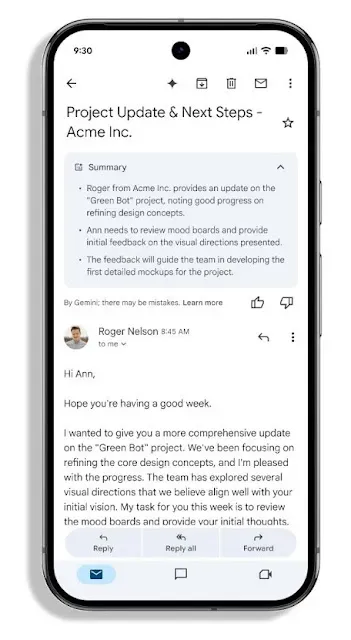
Source: Google
Even with auto-summaries on, users can still run one manually via a chip atop the email or the Gemini side panel in Gmail.Whether auto-summary is on by default depends on region: per Google's support page, it's off by default for privacy reasons in the EU, UK, Switzerland, and Japan.Elsewhere, users can toggle it individually via Gmail's "Smart features" settings. Organizations on Google Workspace can also have admins disable the feature for all users via the admin console.
In Closing
We hope today's stories help you make the most of AI and stay informed.If this was useful, please share it with colleagues or friends who might be interested.We'll keep curating the topics that matter most, bringing you valuable information.Look forward to our next newsletter too.Thank you very much for your continued support.
Related Articles
AI News Flash | Google Integrates Gemini into Chrome
Top 3 Workflow Automation Platforms: Is n8n, Dify AI, or Make the Right Fit for Your Business?
AI News Flash | xAI Officially Unveils Its Most Powerful Multimodal Model, "Grok 4.0"
AI News Flash | Gemini AI's Android Integration Expands, Turned On by Default Regardless of User Settings
AI News Flash | ChatGPT Is Evolving From a "Q&A AI" Into a "Multifunctional Work Partner"