Home › Blog › Development Solutions
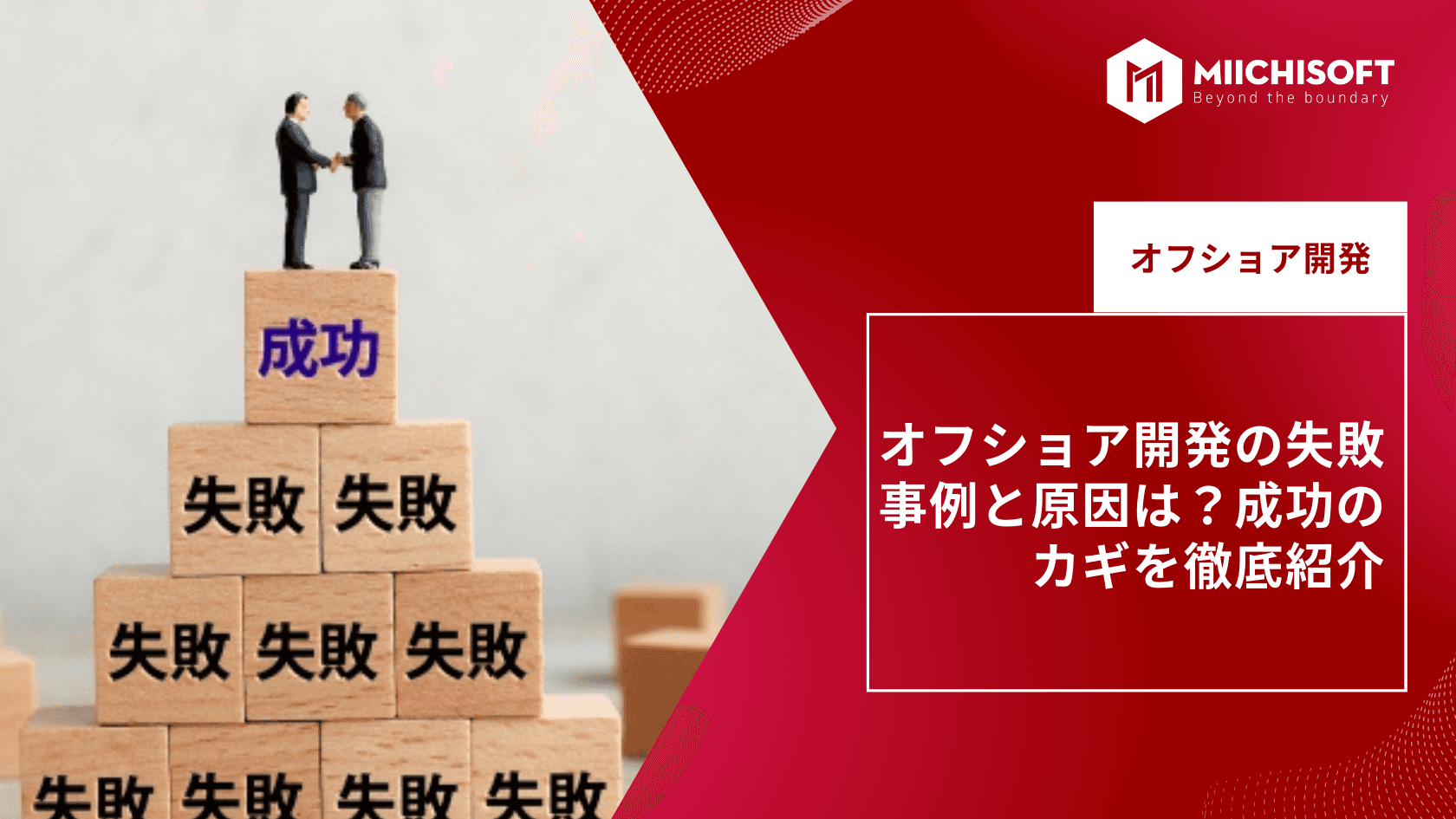
Common Failure Cases and Causes in Offshore Development: A Thorough Guide to the Keys to Success
The pandemic has reshaped business models and driven up demand for DX. Many companies — IT and non-IT alike — now want to digitize to improve efficiency and grow. But building an in-house IT department is costly given the shortage of IT talent, so more companies outsource overseas, including to Vietnam.
Miichisoft has done offshore development for over five years. Here we share common failure cases and causes — we hope you find it useful.
1. What Is Offshore Development?
"Offshore development" means outsourcing systems, software, or web development to an overseas company or subsidiary. "Offshore" — "off" the "shore" — has come to mean "overseas."
When people think of offshore development, they often strongly associate it with benefits such as "cost reduction," "shorter development time," and "securing skilled engineers."
On the other hand, whether or not they have prior experience, many people share anxieties and concerns such as "will communication go smoothly?" and "can quality be assured?"
Here, we introduce common challenges in offshore development, along with improvement measures and our own initiatives.
2. Causes of Offshore Development Failure

2.1. Common Challenge #1 in Offshore Development: The Language Barrier
Since you're outsourcing to an overseas company, communication may genuinely fail to get through.
Without business-level (not just casual) fluency in the foreign language, fine nuances may not come across, and the system may not turn out as intended.
Also, requirements are typically defined on the Japan side and then translated into the offshore destination's language — this is where so-called "specification bugs" caused by mistranslation often occur.
This isn't just about translator skill — Japanese itself tends to express things indirectly, avoiding direct statements. That trait can lead to poor translation and, ultimately, project failure.
2.2. Common Challenge #2 in Offshore Development: Differences in National Character
Different countries have different cultures and ways of thinking. In Japan, "report, contact, consult" (hourensou) is business common sense — that doesn't necessarily hold elsewhere.
It's not uncommon for work content or procedures to change without checking with the client first, which later becomes a problem.
For Japanese people, deadlines are absolute — they'll work overtime to meet them, since trust is on the line. Japan also has a culture of overtime and staying until the boss leaves. That's unique to Japan and doesn't apply overseas, so keep it in mind.
2.3. Common Challenge #3 in Offshore Development: Concerns about Engineers
Of course, many engineers have skills on par with those in Japan. But not all do, and not being able to check each engineer's level in advance is a source of anxiety.
3. How to Solve Challenges in Offshore Development
Solutions for offshore development
3.1. Communicate Proactively
In Japan, there's an assumption that things will be understood even without being said, but that doesn't hold true overseas.
Over-communicate: stay in touch often, check progress regularly, and resolve misunderstandings early.
Close, frequent communication builds trust over time. As noted, Japanese is ambiguous and hard for translators to convey clearly — precisely because the other party is a foreigner, say what you mean clearly and directly, in short sentences.
3.2. Things You Should Know About the Other Party's Culture.
Respecting the other party's culture is the basis of communication in offshore development.
Hold a roughly one-hour weekly meeting to check the project is on schedule, and address delays early.
3.3. Check Development Track Record and Engineer Level
Here are the key points to keep in mind when checking these things.
- Whether they have a similar track record for the kind of development you want.
- Response speed.
- Whether communication with them tends to be easy.
A track record with similar requests means the relevant know-how is likely already there, so work goes smoothly. Fast, courteous responses are a must.
A company slow to respond from the start won't get faster later.
*Note: Having a BrSE in between makes communication easier.
If you're considering offshore development, we also recommend this article.
Reference: 11 Useful Tips for Making the Most of Offshore Development
4. How to Choose the Best Offshoring Partner
Outsourcing overseas is easy, but finding the right partner is hard — companies want to enter the market fast, and relying only on others' success stories isn't enough.
Here are a few suggestions for finding the best offshore provider for your company.
4.1. Look for Your Favorite Vacation Spot.
Start by looking for an offshoring location that fits your needs.
Besides India and the Philippines, other offshore countries like Vietnam and Malaysia are steadily gaining credibility and appeal.
4.2. Choose at Least 3 Organizations Specializing in Business Process Offshoring (BPO)
Don't rely solely on the first BPO company that comes to mind — doing so keeps you from getting the most out of outsourcing.
Shortlist at least three BPO businesses, then evaluate them on quality, price, and effectiveness.
4.3. Check Quality and Cost
A cheaper partner doesn't necessarily mean the best service. Check testimonials from past customers to see how cost and service stack up against work quality.
You can also ask for a free trial to see if it meets your needs.

Offshore development helps make up for Japan's serious IT engineer shortage, but the hurdle is smooth communication with a partner of a different language and culture. Bridge system engineers exist to overcome that barrier, letting the work go far more smoothly.
5. Summary
If you're considering offshore development, we also recommend this article.
Reference: Who Should Use Offshore Development, and for What Purpose?
If you'd like to learn more about offshore development, please feel free to contact Miichisoft.
Related Articles
[Case Study Dify] AI ERP Query Bot Using Natural Language - Retrieve data in seconds
Dify Chatbot Pricing: Complete Guide to Deployment & Operating Costs

[2025] 12 PWA App Case Studies, Explained in Detail
What Comes After Proof of Concept (PoC)? [2025 Edition]

Top 10 IT Outsourcing Companies in Vietnam Experienced in Working with Japanese Enterprises