Home › Blog › Development Solutions
The Worsening IT Talent Shortage and Future Forecasts
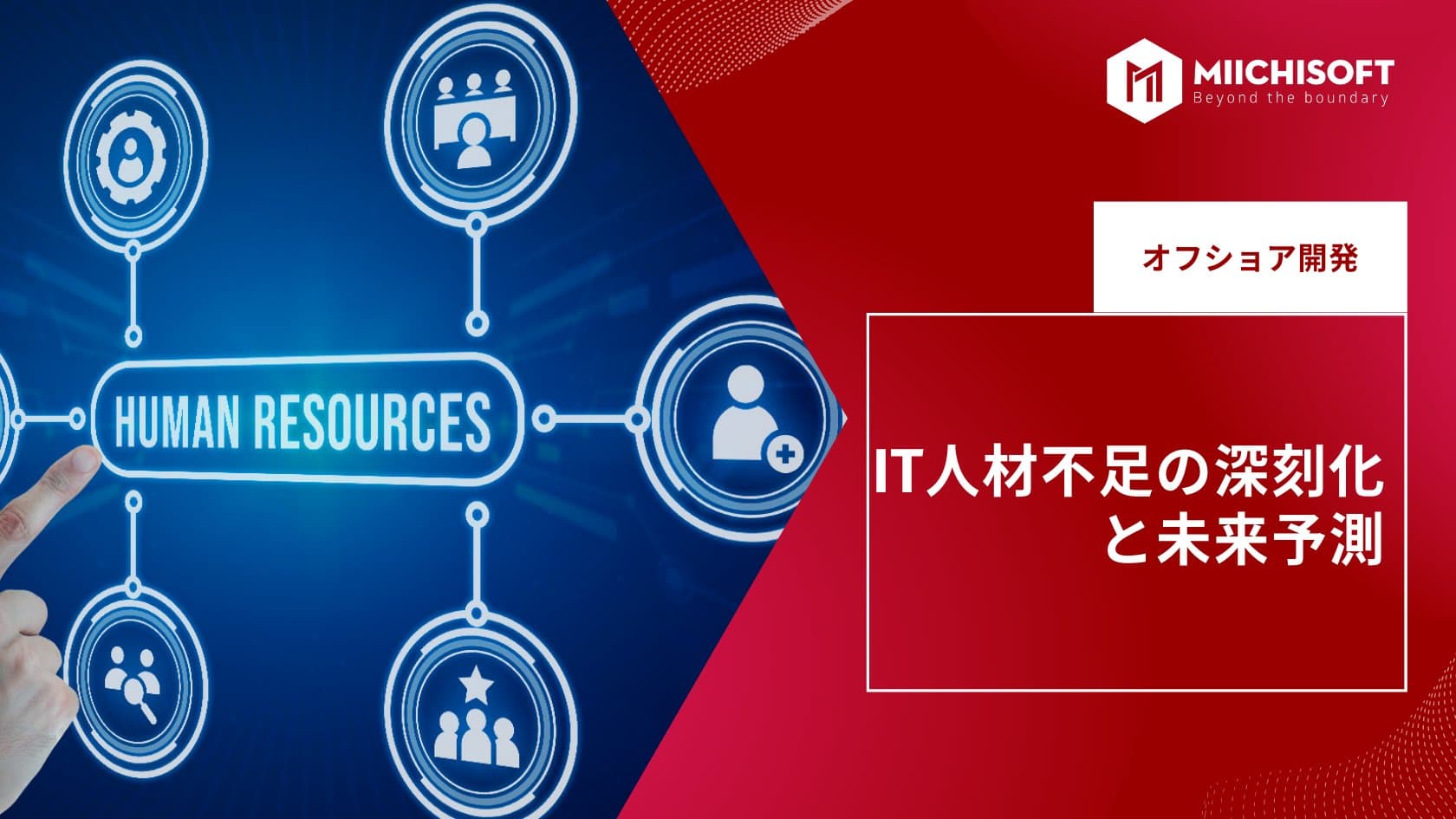
Amid recent conditions, developing IT talent has become an urgent task for many companies. This article explains the worsening IT talent shortage, forecasts for the future of IT talent, and three reasons behind the IT talent shortage. HR staff considering IT talent development are encouraged to use this as a reference.
1. The worsening IT talent shortage
According to estimates released by Japan's Ministry of Economy, Trade and Industry (METI) in 2019, Japan faces a serious IT talent shortage, with up to 790,000 engineers expected to be short by 2030.

Source: METI Survey on Supply and Demand for IT Human Resources
According to the Survey on Corporate Trends Regarding Labor Shortages (April 2022):
- The share of companies reporting a shortage of full-time employees was 45.9%, a sharp increase of 8.7 points from the same month the previous year. In the information services industry in particular, the figure reached 64.6%, highlighting a pronounced IT talent shortage.
- Among non-regular employees, 27.3% reported a labor shortage, up 6.7 points year on year. In "restaurants" and "inns/hotels," where the sense of labor shortage had eased during the pandemic, the shortage is intensifying again.

Source: METI Survey on Supply and Demand for IT Human Resources
2. Future forecast for IT talent
According to METI's 2019 estimates, even as the actual number of available IT staff rises, the shortage of qualified IT staff has reached the same level as the 2015 estimate — likely because demand for IT staff keeps growing along with overall demand for IT.
The number of qualified IT professionals expected to be in short supply by 2030 is estimated at between 410,000 and 790,000. Under one scenario, the shortfall is estimated to reach 587,000 people by the end of the period.
If IT talent productivity improves somewhat, the supply-demand gap above (the difference between actual productivity and a more efficient workforce) would narrow. Factoring in the productivity improvement rate, trial calculations show that at 0.7%, the 2030 gap is estimated at 164,000–787,000 people (around 449,000 at the midpoint).
3. Three reasons behind the IT talent shortage
According to a 2018 IT talent survey commissioned by METI, IT talent is defined as people working in the information services industry who provide IT software services, a segment that keeps expanding. Employees in the IT departments of companies that use IT are also counted as IT talent.
3.1. Expansion of the IT industry
Under METI's classification, the IT industry corresponds to the information services industry (software, information processing/provision services, and internet-related services). Sales across the IT industry have grown since around 1990, and this trend continued through 1998.
A 2013 METI survey found the IT industry employs about 1 million people and generates about 20 trillion yen in sales. In 2010, employee numbers grew 20% in software, 10% in information processing/provision services, and 33% in internet-related services. By sales, growth was 5.8% in software, 30% in information processing/services, and 38% in internet-related services — every segment expanding.
3.2. The advance of the declining birthrate and aging population
According to the Cabinet Office's "2021 Annual Report on the Aging Society," of a total population of 125.71 million, 36.19 million are aged 65 or older. With the population declining, people under 15 make up just 12.0%, and this trend is accelerating each year — suggesting factors beyond the declining birthrate and aging population also contribute to the labor shortage.
3.3. Impact of social conditions
According to a recent report from the Ministry of Health, Labour and Welfare, the number of job openings per job seeker has declined since the pandemic began. Fewer openings might seem to make it easier for companies to find workers, but that isn't always the case.
Job seekers generally choose work matching their skills and desired conditions, which often doesn't line up with what companies need. Even if the labor shortage seems to have eased, competition for employees means companies still fight over a limited pool of workers.
For SMEs and specialized industries, the problem is worsening: job postings fail to attract candidates, and the shortage persists. The pandemic has made running a business the conventional way harder, forcing many companies into a "new normal" for the first time. For face-to-face businesses, added tasks like temperature checks have at times overwhelmed staff, leaving areas like disinfection under-covered.
According to Teikoku Databank's 2021 trend survey, the share of companies experiencing a labor shortage rose to 37.2%. This means organizations nationwide are struggling to find enough qualified employees. Amid the pandemic, other factors — declining birthrate, aging population, and changing work styles — may also be making it harder to find qualified workers.
4. Miichisoft'sLAAS - High-Quality Product Development Team Service
4 reasons to choose LAAS at Miichisoft
1. Cut project development costs by up to 50%.
Normally, building a team equivalent to 10 Japanese staff requires 1 Japanese staff member plus 10 offshore staff. With LAAS, you can cut costs by up to about 50%. The larger the team, the greater the cost-saving effect.
2. A project development team that works alongside Japanese staff
This is what sets Miichisoft apart from other companies. Because Miichisoft also has an entity in Japan, we can understand your requests more clearly and move project work forward more smoothly.
3. Access to advanced skills and knowledge from a highly skilled team
Our engineers are selected from top universities in Vietnam and undergo the latest training programs, so they're trained early on to handle many different business needs. On top of that, having obtained AWS Consulting Partner status and ISTQB (JSTQB) Gold Partner certification allows Miichisoft to keep growing strongly and deliver even more value to our clients.
4. Easy, secure, and fast
We work hard to guarantee complete security so that we can support our clients' technology needs over the long term. We hold ISO 9001:2015 certification for quality management and ISO/IEC 27001:2013 certification for information security management.
Miichisoft's slogan is "Technology Supporter."
We look forward to your IT inquiries at any time. We hope for a valuable connection between you and Miichisoft.
Related Articles
[Case Study Dify] AI ERP Query Bot Using Natural Language - Retrieve data in seconds
Dify Chatbot Pricing: Complete Guide to Deployment & Operating Costs
[2025] 12 PWA App Case Studies, Explained in Detail
What Comes After Proof of Concept (PoC)? [2025 Edition]
Top 10 IT Outsourcing Companies in Vietnam Experienced in Working with Japanese Enterprises