Home › Blog › Development Solutions
What Is MVP Development? A Thorough Look at the Difference From PoC and How to Build One
Developing an MVP is a great way for companies to validate an idea. 70% of tech startups fail within two years of their first funding round because they don't meet market needs — usually due to a lack of market research.
Testing with an MVP is key to avoiding this failure. It helps gather feedback from potential customers and pinpoint what your product truly needs.
An MVP lets you validate an idea's real potential versus its assumed potential, guiding your development direction.
MVP (Minimum Viable Product) can be used by any company in any industry, aiming to refine and launch a product that quickly gains momentum, while promoting a brand cost-effectively.
This article covers everything you need to know about MVP development, from business approaches to benefits, costs, and potential applications.
Finally, we'll cover what you need to get started.
1. What is Minimum Viable Product (MVP) development?
An MVP - Minimum Viable Product - is an early product version with only the features early customers can use. Their feedback directly shapes what gets built next.
By focusing on releasing an MVP early, a brand avoids lengthy, unnecessary changes that can arise from releasing a fully finished, untested product to market.
An MVP lets companies quickly test, refine, and launch a product, capturing customer attention faster than competitors. It also gives early adopters a chance to interact and connect with the product, helping build and promote a specific brand image. It can be a truly critical asset in uncovering what your target audience actually expects.
By understanding user expectations, you can strategically prioritize development, avoiding wasted time and resources on unwanted features.
There are four key aspects of MVP product development:
- It must be small in scale
- It needs to be simple
- The number of features must be limited
- MVP development must be fast and cost-effective
Fundamentally, it comes down to carefully choosing the MVP's features. An MVP isn't a sketch or wireframe — it's a bare-bones but functional product.
In that sense, it needs all the components of a full application: functionality, reliability, usability, and good design.
2. What's the difference between PoC and MVP development?
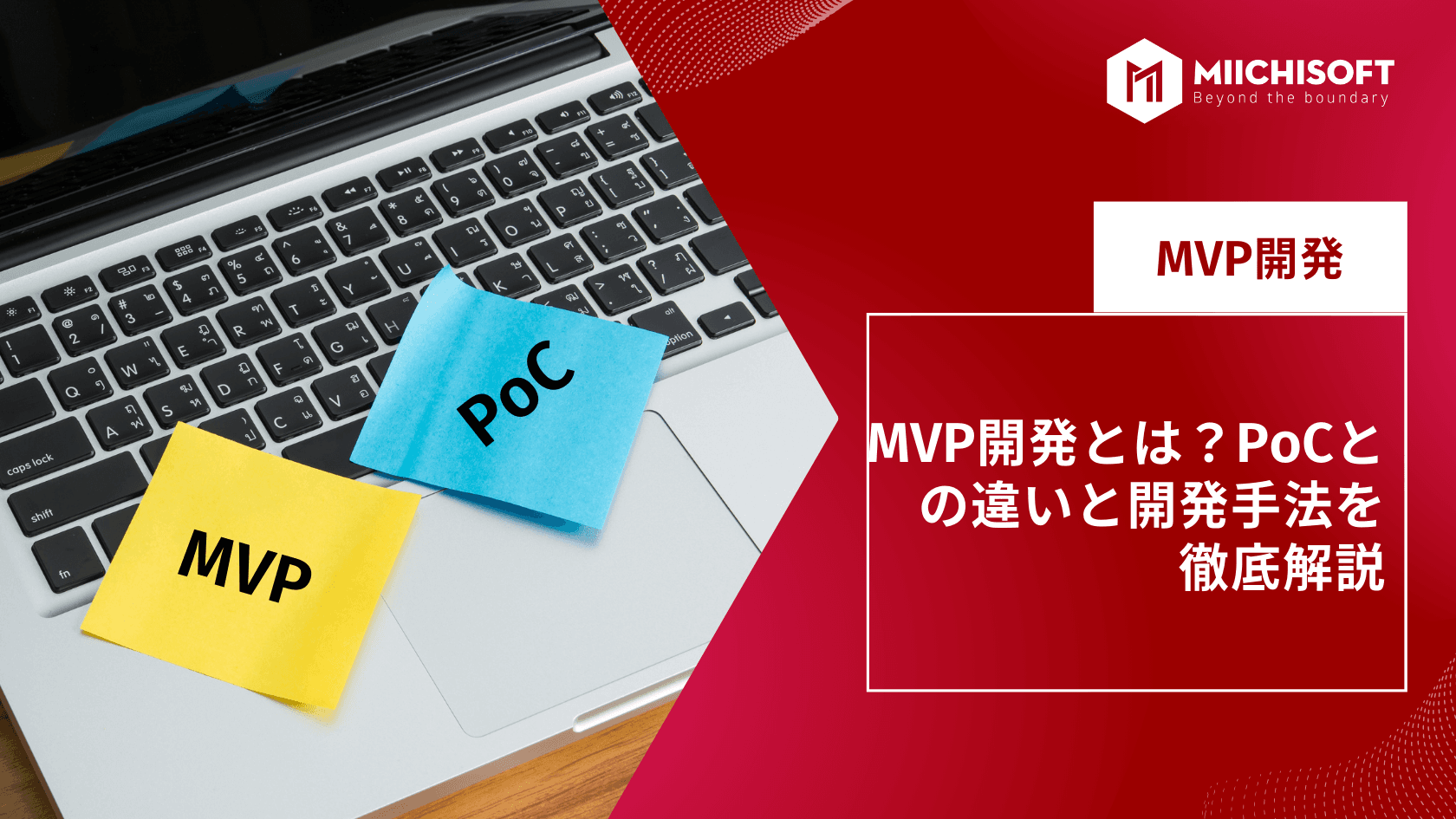
An MVP is neither a prototype nor a proof of concept (PoC).
A prototype is a draft version showing a specific visual form or piece of functionality. It's usually discarded, or carried over in some form into the MVP or final product.
A proof of concept - PoC development is usually an internal experiment giving a realistic outline of a potential project to determine feasibility, mainly to validate a technical concept.
These concepts can include methodology, technology, or integrations, plus scalability and rentability. Applicable across fields, it's a fundamental step for building a prototype and analyzing market feasibility.
In essence, it evaluates whether a product can be built with given resources and technology. Both approaches are extremely useful for product management, validating various product hypotheses.
2.1. Benefits of MVP development
- Validating desirability and feasibility
- Saving and optimizing time and cost
- Attracting early-adopter customers after testing the first version of the product
- Gaining market proof and your first paying customers
- Catching the attention of venture capital investors
2.2. Benefits of PoC development
- Validating feasibility
- Attracting angel investors
- Saving time
- Choosing the optimal technology
- Staying one step ahead of competitors
3. Why is MVP development important?
By now you understand what an MVP is. Let's look at why it matters for a business.

Why is MVP development important?
Simply put, MVP development lets you address your audience's first concerns in a timely way.
The MVP concept lets you build a product with little to no risk, and determine the minimum requirements needed for the new product's user base.
Once these minimum requirements are set, you can quickly release a bare-bones version, then use results and feedback to refine and strengthen it.
Essentially, MVP development enables real-time improvement and agility.
An agile MVP not only improves the product about to launch, but streamlines your workflow, saving significant time on later development and maintenance.
That said, moving forward with an MVP framework means understanding the product isn't ready right away — if customers aren't satisfied, more work is needed to bring the MVP up to its best state.
- The key benefit is quickly delivering value to end users, while gathering critical feedback with minimal upfront cost.
- You can change or remove flawed or unneeded features without extra resources, uncover insights into customer behavior and market segments, and fix early mistakes more easily and cheaply than errors found in a complete product.
- MVP development is the best tool for early-stage testing. Insights from this phase let you plan ongoing development more accurately, and build a product vision that lets your user base grow.
- A fully tested, validated product idea also helps convince investors your business is worth supporting.
- Finally, an MVP makes pivoting easier, since shifting focus or changing core functionality costs less.
4. MVP development checklist and flow
Before starting MVP development, it's important to distinguish between the two MVP build types: a mobile app and a web app.
Technically, the only real difference is which technology you use to build the product.
Since an MVP is meant to be a quick, simple first step toward iterative development, you need to know your target market and platform first.
Otherwise, you risk entering the project with divided focus, undermining your MVP.
Launching a web-app MVP is often faster, since it skips required authentication protocols and app-store submissions. Interestingly, some of the world's biggest web companies, like AirBnb and Facebook, started as web apps before expanding to mobile.
That said, if most of your market is mobile, a web MVP won't do you much good.
Remember, the mobile market splits between iOS and Android. If entering both stores is your goal, look for multi-platform technology such as Flutter or React Native.
4.1. The best MVP development method and flow
4.1.1. Set your business needs and conduct preliminary market research
The critical first step is to clearly define the business needs and goals your MVP needs to meet.
Sometimes this is easy. But if it isn't, good product design will help you avoid mistakes. Projects generally don't succeed by accident.
They succeed by solving real challenges and problems, so clearly define the challenge before you get started.
To do this, conduct market research as your first step.
Seek feedback from key stakeholders such as investors, customers, and industry experts. There's always a chance that a similar solution is already on the market.
That doesn't necessarily mean your idea is worthless. In fact, understanding how similar products are perceived and how successful they are can help you improve on them, or find a specific niche to fill.
4.1.2. Identify your product's must-have features, versus nice-to-have or bonus features
Next, create a list of the traits and features your product needs to generate value for users.
The next step is to list out all the features you want your product to have in order to create value for customers.
To do this, map out the user journey and how that journey flows as users interact with the product, with a focus on usability.
Of course, you also need to know what your product's unique selling proposition (USP) is. This way, you can develop an MVP that proves why your product is special.
When building this list, sort features into three categories: must-have, nice-to-have, and bonus.
This way, you can narrow down what your product's essential elements are — that is, what needs to be built, and who you need to hire.
4.1.3. Consider running a proof-of-concept (PoC) phase
As mentioned earlier, a PoC is extremely useful for validating early-stage technology, and it has the added benefit of building confidence — among the strategy and development team, investors, and other stakeholders — that the MVP is likely to succeed.
4.1.4. Clarify your success criteria
If you don't know what you're aiming for, you won't know whether your MVP is a success.
So define a measurable set of criteria or KPIs to help determine which aspects of the product are worth spending more time and resources on during development.
4.1.5. Measure your progress
Once the previous four steps are complete, you can start development. Following step 4, it's important to measure progress and learn from it.
This lets you use your time wisely and pivot toward feedback to build momentum.
4.1.6. Minimal doesn't mean messy
Throughout this process, you need to focus on keeping the "M" in MVP in mind. That said, just because a product is the smallest workable version of itself doesn't mean it needs to be cluttered or sloppy.
The development team needs to build the product's core functionality as needed to address the defined problem.
However, these core features still need to be well designed and keep users interested and engaged. This is what defines the "viable" part of Minimum Viable Product — usable, and effective at attracting more users.
4.1.7. Don't cut corners, and make use of experts
It might be tempting, but you can't cut corners and expect to come back and fix problems later.
Likewise, make use of the expertise available within your team or agency, and don't compromise when it comes to product expertise.
MVP development should be treated as the most effective way to quickly test and release a product, but it's important to remember that it still represents your brand.
Don't overuse flashy features. Once your core functionality is validated and in place, there will be time for that.
Always track user behavior and sentiment, so you can learn how your MVP is performing and refine the original idea behind it.
4.1.8. Other considerations along your MVP journey
Viable means it's usable and can solve problems with its core functionality.
Once your MVP starts selling, if the market is large enough, you'll need to think about making the MVP scalable in case of a surge.
Keep in mind that an MVP is not a prototype. A prototype is a first pass that can be discarded if it's not right. An MVP forms the foundation on which the final version of the product is built, and like any building's foundation, it needs to be robust and durable enough to serve its purpose.
As with any other software development process, pitfalls can arise if the process is flawed or doesn't fit the company.
Related Articles
[Case Study Dify] AI ERP Query Bot Using Natural Language - Retrieve data in seconds
Dify Chatbot Pricing: Complete Guide to Deployment & Operating Costs
[2025] 12 PWA App Case Studies, Explained in Detail
What Comes After Proof of Concept (PoC)? [2025 Edition]

Top 10 IT Outsourcing Companies in Vietnam Experienced in Working with Japanese Enterprises