Home › Blog › Development Solutions
IaaS: Features and Future Potential? Explaining the Differences Between PaaS and SaaS
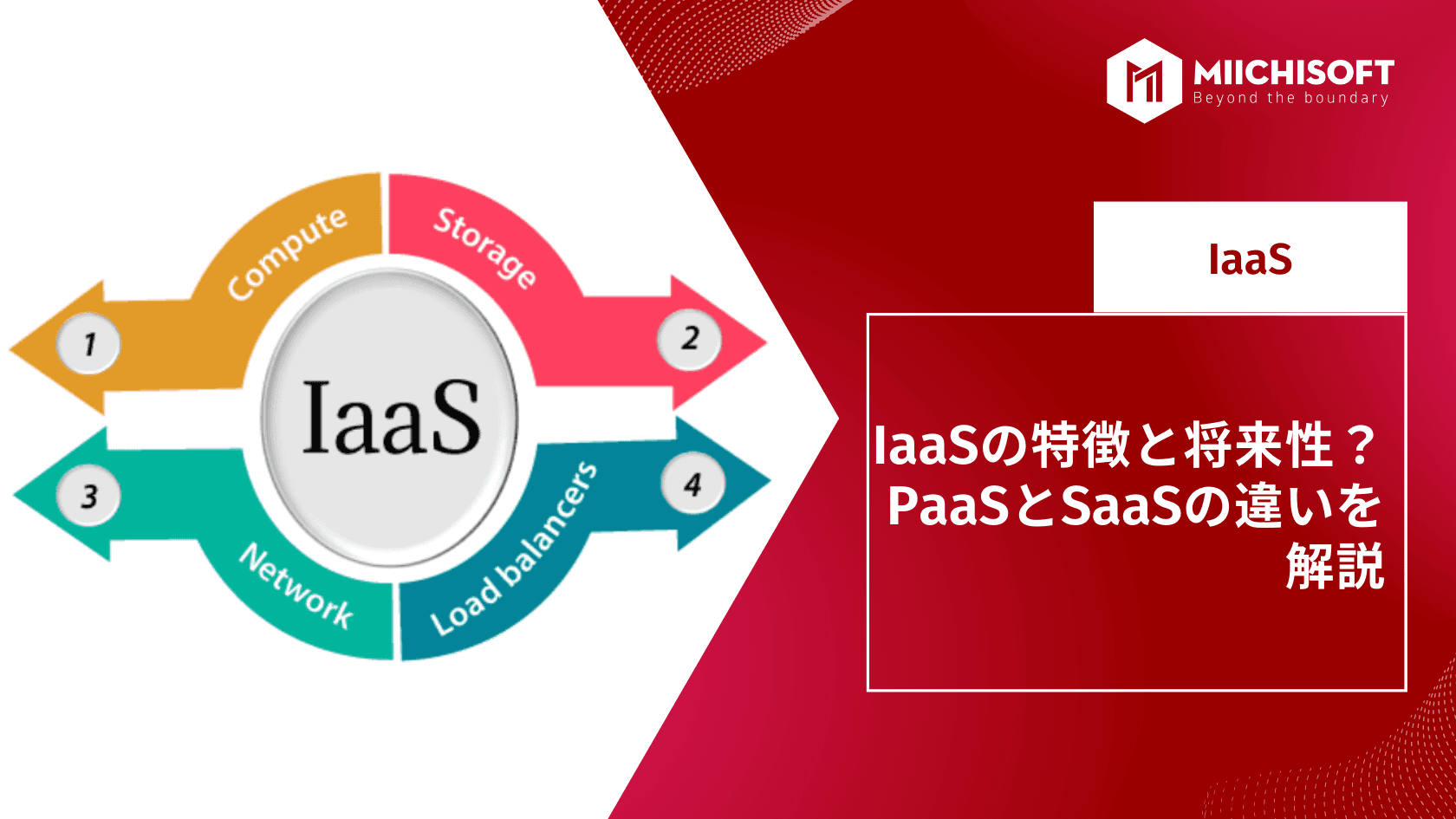
Maintaining on-premises IT infrastructure can be a huge burden, both in cost and effort. That's why companies pursuing a digital strategy are seeing customer demand for the cloud as IaaS (Infrastructure as a Service) accelerate rapidly.
IaaS promises on-demand access to computing resources, making it a groundbreaking service. Here, we'll introduce IaaS in cloud computing, along with its benefits, challenges, and examples.
1. What Is the Definition of IaaS (Infrastructure as a Service)?
The official definition of IaaS is as follows: IaaS (Infrastructure as a Service) provides compute, memory, storage, networking, and related software such as operating systems and databases as a cloud service, replacing the infrastructure of a traditional on-premises data center.
Put simply, IaaS is basically a virtual server, which customers rent from another company that owns a data center. Essentially, IaaS promotes access over ownership.
This solution gives end users the flexibility to host custom-made applications or standard software, while also providing a general-purpose data center for storage.
IaaS can be deployed under any of the three service models defined by the U.S. National Institute of Standards and Technology (NIST).
1.1. IaaS Model: Private Cloud
The infrastructure service is provisioned for exclusive use by a single organization. The physical infrastructure may be owned, managed, and operated by that organization, a third party, or a combination of both, and can exist on-premises or off-premises.
1.2. IaaS Model: Public Cloud
The infrastructure service is provisioned for open use by multiple organizations (also called a multi-tenant model). The physical infrastructure may be owned, managed, and operated by a business, academic institution, government body, or a combination of these, and it resides on the premises of the cloud provider.
1.3. IaaS Model: Hybrid Cloud
Companies that choose to leverage both public and private clouds for their applications and overall architecture. These two cloud models each exist independently, but are bound together by standardized or proprietary technology that enables data and application portability.
2. Benefits and Features of IaaS
IaaS is advantageous for companies in scenarios where scalability and rapid provisioning are key. In other words, a fast-growing company that doesn't have the capital to invest in hardware is an ideal candidate for the IaaS model.
IaaS is also beneficial for companies with stable application workloads that want to offload some of the routine operations and maintenance involved in infrastructure management. Other benefits include the following.
- Pay only for what you use, with a usage-based pricing model
- Reduce capital expenditure — IaaS is typically paid as a monthly operating expense
- Dynamic scalability — rapidly add capacity at peak times and scale down as needed
- Improved security — IaaS providers invest heavily in security technology and expertise
- Future-ready operations — access to cutting-edge data centers, hardware, and operating systems
- Self-service provisioning — easy access via an internet connection
- Reallocation of IT resources — free up IT staff for higher-value projects
- Reduced downtime — IaaS enables immediate recovery from failures
- Increased speed — once IaaS machines are provisioned, developers can start the project
- Enabling innovation — adding new features and leveraging APIs
- Leveling the playing field — small and midsize businesses can compete with large enterprises
3. The Size of the IaaS Market and Its Future Challenges
3.1. Market Size of the IaaS Industry

On June 2 (US time), Gartner published the results of its 2021 worldwide IaaS market survey. According to the results, the market grew 41.4% year over year to $90.9 billion (about ¥11.8 trillion). The top 5 vendors, in order, were Amazon, Microsoft, Alibaba, Google, and Huawei, with Amazon and Microsoft together accounting for 60.0% of the overall market, and the top 5 accounting for 81.2%.
Gartner analyst Sid Nag (Vice President) commented, "The IaaS market continues to grow unabated as cloud-native becomes the dominant architecture for workloads."
Market size of the IaaS industry
3.2. Challenges of IaaS
While using IaaS within an organization offers many benefits, it also comes with challenges. Some of these hurdles can be overcome with advance preparation, but there are also risks customers should consider before adoption.
Possible challenges include the following.
- Unexpected costs — monthly fees adding up, peak usage exceeding expectations, and process changes. Adopting IaaS may require changes to processes and workflows
- Runaway inventory — deployed instances that never get decommissioned
- Complex integration — integrating with existing systems
- Security risks — losing direct control can introduce new vulnerabilities
- Limited customization — public cloud users may have limited control and ability to customize
- Broadband dependency — reliability depends on internet connectivity
- Confusing SLAs — understanding a service-level agreement (SLA); regulatory uncertainty — changes in federal and state law may affect industries using IaaS across borders in particular
- Vendor consolidation — a provider could be acquired or go out of business
- Third-party expertise — a lack of mature service providers, guidance, and ecosystem support
4. Introducing the Top 4 IaaS Companies and Service Examples
4.1. IaaS Example: Microsoft Azure
Microsoft Azure is a cloud computing service created by Microsoft that lets you build, test, deploy, and manage applications and services through data centers managed by Microsoft.
4.2. IaaS Example: Amazon Web Services
Amazon Web Services is a secure cloud service platform that offers computing power, database storage, content delivery, and other capabilities to help businesses expand and grow.
4.3. IaaS Example: Rackspace
Rackspace is a managed cloud computing company aimed at making it easy to manage private and public cloud deployments. It's the largest managed cloud provider, offering expertise across cloud platforms such as AWS, Microsoft Azure, and OpenStack.
4.4. IaaS Example: Google Compute Engine
Google Compute Engine is Google's IaaS virtual machine offering. Instead of acquiring and managing server hardware, it lets you use powerful virtual machines in the cloud as your server resources.
5. Explaining the Differences Between IaaS, PaaS, and SaaS

IaaS (Infrastructure as a Service) is one of the three most common cloud computing services. IaaS is typically a pay-as-you-go service that includes services, storage, networking, virtualization, and more. But how does IaaS compare to its fellow service models?
PaaS (Platform as a Service) consists of hardware and software tools built on top of an IaaS platform. PaaS reduces the need for system administration, letting end users focus on application development instead of infrastructure management.
Meanwhile, SaaS (Software as a Service) is ready-to-use software available over the internet through a third party. Many recent SaaS applications are built on top of IaaS or PaaS platforms.
The difference between IaaS, PaaS, and SaaS
It's no surprise that newer cloud models are entering this space alongside IaaS. Containers and serverless architectures are service models that offer new options for how applications are run. For now, simple IaaS solutions remain the most mature option, but trend-watchers are keeping an eye on containers and serverless architecture as emerging technologies.
The range of services offered by IaaS providers is vast and constantly evolving, but before choosing a cloud service provider, you should always assess and prioritize your business needs. Companies need capable IT professionals who can analyze, evaluate, and design cloud computing solutions that fit current and future needs.
6. Frequently Asked Questions About IaaS (FAQ)
What is IaaS?
IaaS is a way of using computers over the internet. With IaaS, the very infrastructure needed to build and run a computer system is provided as a service over the internet.
It seems like AWS and Azure are often used for cloud services?
According to Gartner's 2021 global IaaS market survey, Amazon and Microsoft together accounted for 60.0% of the overall market, and the top 5 — Amazon, Microsoft, Alibaba, Google, and Huawei — accounted for 81.2%.
What's the difference between IaaS, SaaS, and PaaS?
SaaS handles operation and management all the way up to the application used by end users; PaaS manages the middleware and server OS needed to provide a development environment; IaaS mainly handles maintenance and management of the hardware.
https://youtu.be/ygrMu5HrRAk
7. In Closing
IaaS can bring companies many benefits — faster, easier, more flexible, and more cost-efficient workloads.
As technology keeps evolving, so will the IaaS model. Overall, IaaS offers a broad range of benefits for both suppliers and users. Companies will keep needing capable IT professionals who can analyze, evaluate, and design cloud computing solutions that fit both current and future needs.
Related Articles
[Case Study Dify] AI ERP Query Bot Using Natural Language - Retrieve data in seconds

Dify Chatbot Pricing: Complete Guide to Deployment & Operating Costs

[2025] 12 PWA App Case Studies, Explained in Detail

What Comes After Proof of Concept (PoC)? [2025 Edition]

Top 10 IT Outsourcing Companies in Vietnam Experienced in Working with Japanese Enterprises