Home › Blog › Development Solutions
Web 3.0: A New Era of the Internet
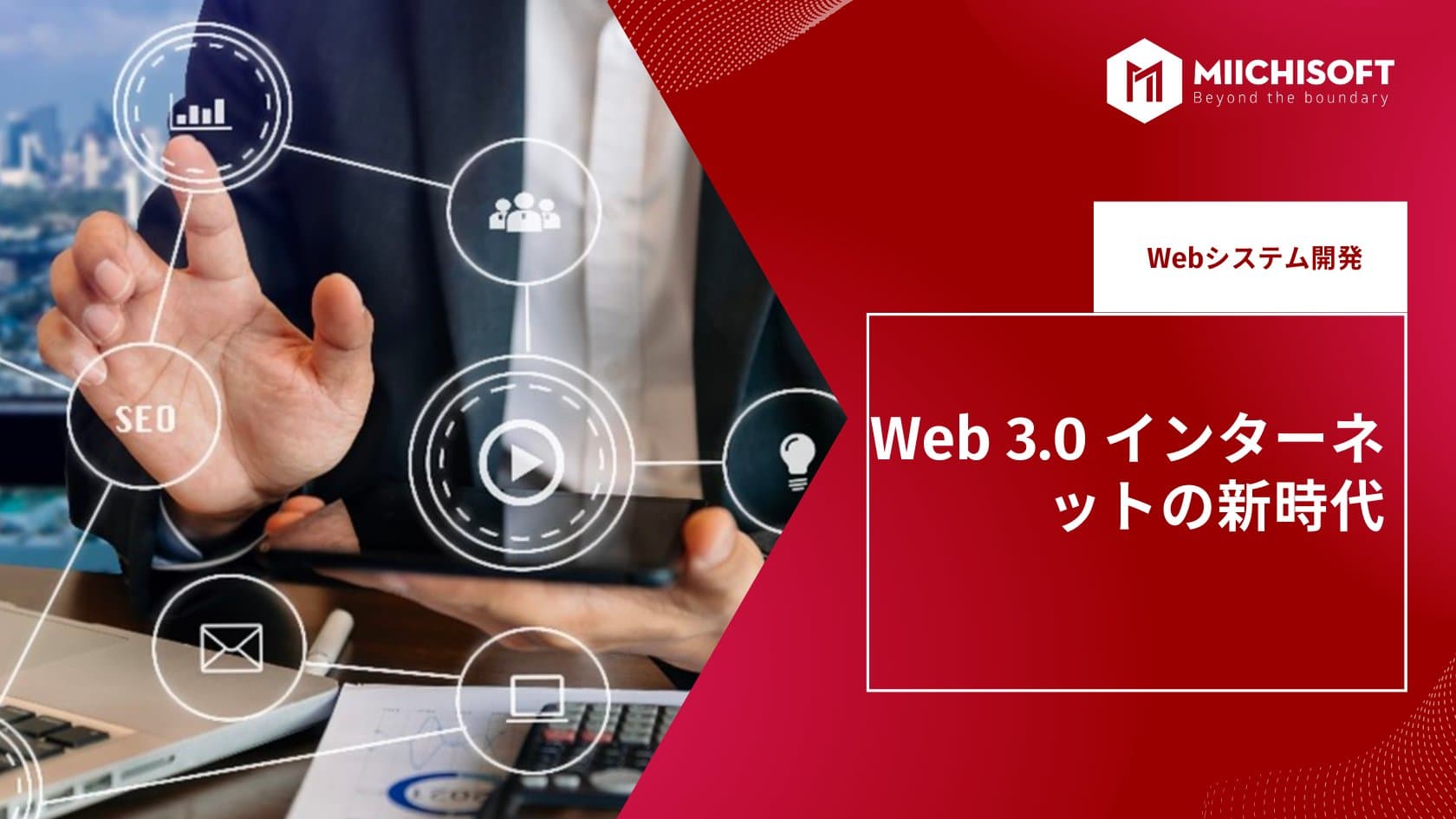
This article introduces Web3.0, a term getting a lot of attention lately. Since Web3.0 is a keyword worth watching going forward, it's worth knowing the basics.
1. The Concept of Web3.0 and Its Background
Since this is "Web 3.0," let's first look at Web1.0 and Web2.0. Understanding the context makes clear why Web3.0 is needed and why it matters.
1.1. Web1.0
In a word, Web1.0 was defined by "browsing." It spanned roughly from the mid-1990s to the early 2000s. Most pages were written in static HTML, and publishing information required knowledge and skills in HTML. So only a limited number of people were able to use it.
1.2. Web2.0
From the mid-2000s onward, Web 2.0 has repeatedly been mentioned as a representative keyword symbolizing a new trend on the web. The key difference from Web1.0 is that many people became able to not just browse, but also become publishers of information.
With the spread of social media and YouTube, people became able to publish information without the specialized knowledge that Web1.0 required, rather than just browsing it. On YouTube, videos uploaded by ordinary people often rack up hundreds of thousands of views.
1.3. Web3.0
Web3.0 is also known as the "next-generation internet."
Put simply, it could be described as "the era of the decentralized internet." Web3.0's decentralized management has the potential to resolve the problems caused by Web 2.0's centralization, and blockchain technology is what makes this decentralization possible. Blockchain technology can be said to be indispensable to realizing Web3.0.
2. Benefits of Web3.0
2.1. Improved Security Level
The first benefit is an improved level of security.
Simply put, blockchain uses cryptography to link transaction records into a chain, maintaining an accurate transaction history.
A decentralized network built on blockchain encrypts data such as transaction history, only approving transactions once multiple users give their approval.
From a hacker's perspective, hacking a blockchain-based service is extremely difficult. Since information is distributed rather than concentrated on one server, hackers must attack multiple devices at once — raising the level of security.
2.2. Use Services Without National Borders
The second benefit is being able to use, and be offered, services without restrictions based on nationality or ethnicity.
For example, China has a censorship system known as the Great Firewall, and the Chinese government blocks access to websites such as Google. This is because the state manages and controls individuals' information.
In Web3.0, on the other hand, state control over personal information stops working. Since blockchain has no centralized server, the state cannot impose access restrictions.

2.3. Reduced Risk of Managing Personal Information
The third benefit is being able to manage your own personal information.
Have you ever browsed a site that came up in a search, and then seen ads for similar sites afterward? This is due to ads (remarketing ads) that track and display content based on your personal browsing history.
Some users may see this as a benefit, but many others find it unpleasant, as if they're being watched. Since Web3.0 lets you manage your own data, it's also possible to block ad delivery altogether.
3. Examples of Services Using Web3.0
A number of services using Web3.0 have already emerged. Here, we introduce one representative example.
3.1. Filecoin
Filecoin is a type of cryptocurrency, a token for a decentralized storage network.
As a blockchain project representing "Web3.0," it attracted strong interest from crypto investors early on. Filecoin drew attention for its groundbreaking approach of utilizing unused storage space.
Digital devices like smartphones already outnumber the world's entire population, yet nearly half are said to sit unused (idle). Filecoin taps into this idle storage space.
4. Miichisoft's Strength in Blockchain Development
Beyond offshore development, Miichisoft has worked on numerous web system and blockchain projects. Our bridge engineers combine technical expertise with fluent Japanese, letting us flexibly handle requests from Japanese companies too.
5. Conclusion
In this article, we've introduced the changes that come with the shift from the earlier eras of Web1.0 and Web2.0 to Web3.0.
Web2.0 may now feel like a given part of everyday life, but many still don't feel Web3.0 is close to them. However, since blockchain-based services already exist, it will likely spread widely before long.
We hope what we've introduced in this article proves helpful for how you interact with the web in your daily work and life.
Related Articles
[Case Study Dify] AI ERP Query Bot Using Natural Language - Retrieve data in seconds
Dify Chatbot Pricing: Complete Guide to Deployment & Operating Costs
[2025] 12 PWA App Case Studies, Explained in Detail
What Comes After Proof of Concept (PoC)? [2025 Edition]

Top 10 IT Outsourcing Companies in Vietnam Experienced in Working with Japanese Enterprises