Home › Blog › AI & Generative AI
[2024 Update] | Implementing Generative AI Chatbots in the Enterprise: A Comprehensive Guide to Effective Adoption

In the age of digital transformation, enterprise success depends heavily on the quality of the customer experience. In this article, generative AI chatbots are drawing attention as an innovative tool that dramatically improves customer support and sales processes. This article explains in detail the concept of generative AI chatbots, the process for implementing them in an enterprise, and Miichisoft's dxGAI chatbot solution.
1. What Is a Generative AI Chatbot?
An AI conversational bot is an advanced system that leverages natural language processing (NLP) and machine learning (ML) technology to generate human-like dialogue. Unlike traditional rule-based chatbots, generative AI chatbots use large language models (LLMs) to generate human-like responses.
These models are trained on vast amounts of text data, enabling them to understand context and generate relevant, coherent responses. Well-known examples include OpenAI's GPT-4 and Google's Gemini. Rather than simply selecting a predefined response, a generative AI chatbot crafts a unique response for each dialogue.
The main characteristics of a generative chat AI are as follows:
+ Natural dialogue:Generates human-like conversation, achieving deep engagement with users.
+ Context understanding:Remembers past exchanges to provide more appropriate responses.
+ Personalization:Learns user preferences and behavior patterns to deliver a personalized experience.
+ Multitasking ability:Handles diverse tasks such as answering questions and summarizing documents.
+ Continuous learning:Learns from new conversations, improving performance over time.
For enterprises, generative chat AI has the potential to transform customer service. It offers many benefits, including 24/7 availability, handling complex inquiries, and delivering personalized experiences. It can also be used across various departments, such as HR, IT support, and marketing.
The above outlines the concept and benefits of integrating generative AI chatbots into typical enterprise operations. Concepts like chatbot, AI, and generative AI may be difficult for some to distinguish. Miichisoft has published an article explaining the differences between these concepts, along with the benefits and trends of generative AI chatbots, in detail. See the link below for more.
https://miichisoft.com/generative-ai-chatbots-vs-traditional-chatbots
2. The Process for Implementing a Generative AI Chatbot in an Enterprise
This section explains the necessary steps for introducing a generative AI chatbot into your company's business.
Effectively implementing generative chat AI requires a careful process. Below are the key steps for success.
2.1. Data Collection and Preparation
Data collection and preparation: The performance of a generative AI chatbot depends heavily on the quality and quantity of the data used for training. Enterprises need to gather all relevant information, including past customer interactions, FAQ documents, product manuals, and internal policies.
However, simply gathering data isn't enough. It must be cleaned and structured — removing personal information, filtering inappropriate language, and correcting inconsistent information. Labeling the data also helps the chatbot better understand context.
Below is a model illustrating the data enterprises need to prepare and the process for handling that data.
Conversational AI and Chat Data Collection and Preparation
2.2. Customizing the Language Model
The next step is customizing the generative AI model to fit your enterprise's needs. This enables more accurate, relevant responses.
The heart of a generative AI chatbot is its language model. The language model customization step involves adapting a general-purpose language model to a company's specific needs — meaning it learns industry-specific terminology, brand voice, product names, and internal processes.
+ Domain-specific fine-tuning:Uses collected data to train the model on industry-specific terms and concepts.
+ Tone adjustment:Sets an appropriate tone — formal, casual, empathetic, and so on — to match the company's brand.
+ Multilingual support:Adapts the model to support major languages, serving a global customer base.
+ Bias mitigation:Removes bias from the dataset and trains the model to generate fair, ethical responses.
For example, a tech company's chatbot needs to understand technical terms like "cloud migration," "API endpoint," and "debugging." A fashion brand's chatbot, meanwhile, needs to be well-versed in fashion terms like "SS," "asymmetric design," and "multiway."
2.3. Testing and Fine-Tuning
After customizing the language model, extensive testing and fine-tuning are needed. This includes evaluating the chatbot's performance across various scenarios, verifying the accuracy and appropriateness of its responses, and identifying edge cases.
Testing may take the form of A/B testing, comparing different chatbot versions to determine which achieves the best customer satisfaction and conversion rate. Sentiment analysis tools can also be used to assess whether the chatbot's responses meet users' emotional needs.
Testing and Fine-Tuning for Generative AI Chatbot Implementation
2.4. Integration With Existing Systems
A generative AI chatbot shouldn't operate in isolation — it needs to be tightly integrated with a company's existing systems. This includes CRM (customer relationship management) systems, ERP (enterprise resource planning) software, and help desk tools.
This integration allows the chatbot to access customer purchase history, support tickets, account information, and more. As a result, it can provide more personalized support and smoothly hand off to a human staff member when needed.
For example, Miichisoft's dxGAI chatbot can provide industry-standard integration mechanisms. The chatbot connects to business tools such as Slack, Notion, WhatsApp, and Zapier.
Conversational AI Bot Integration With Existing Systems
If you're interested in integrating a generative AI chatbot into your business and boosting revenue, check out the success stories at the link below.
https://miichisoft.com/generative-ai-chatbot-features-mechanisms-use-cases
2.5. Beta Testing and Feedback Collection
After testing in a controlled environment, the next step is beta testing. This means releasing the chatbot to a small group of test users and evaluating its performance under real-world conditions.
The goal of this phase is to verify how the chatbot handles various types of queries and conversation styles. It also lets you assess system scalability and check response times and availability under high traffic.
During beta testing, it's important to gather both quantitative and qualitative feedback. Quantitative metrics include accuracy rate, resolution rate, and average conversation time. Qualitative feedback includes user video interviews, open-ended surveys, and social media sentiment analysis.
The dxGAI chatbot comes with an advanced analytics dashboard to streamline this process. It displays real-time performance metrics and identifies areas needing improvement. It also uses AI to analyze user feedback and generate actionable insights.
Beta Testing and Feedback Collection
2.6. Continuous Updates and Improvement
In the world of AI, there's no such thing as "finished learning." Language evolves, business needs change, and new technologies emerge. Generative AI chatbots must therefore be continuously updated and improved.
This continuous improvement includes the following:
+ Adding information about new products or services
+ Adjusting for seasonal promotions and events
+ Retraining with new customer data
+ Upgrading to the latest version of the language model
+ Learning from error logs and edge cases
2.7. Ensuring Conversational Consistency
A great generative AI chatbot needs to maintain consistency not just within a single interaction, but across multiple interactions. This means remembering previous conversations, tracking personal preferences, and responding based on preceding context.
For example, if a customer previously showed interest in a specific product model, the chatbot should remember that information and use it for future recommendations and support. Also, if a customer uses a pronoun like "that" or "my previous issue," the bot needs to understand the correct reference.
2.8. Evaluating Effectiveness and ROI
Implementing a generative AI chatbot requires substantial investment, making it important to evaluate its return on investment (ROI). This evaluation should combine both quantitative and qualitative metrics.
Quantitative metrics include the following:
+ Cost reduction: Lower workload for human agents
+ Revenue growth: Increased sales and upselling through the chatbot
+ Reduced processing time: Average time to resolution
+ Reduced escalations: Percentage of chats transferred to human agents
Qualitative metrics include the following:
+ Customer satisfaction (CSAT) score
+ Net Promoter Score (NPS)
+ Brand reputation (via social media analysis)
+ Employee satisfaction (from reduced repetitive work)
2.9. Ensuring Security and Privacy
A generative AI chatbot accesses large volumes of sensitive information, including customers' personal data and a company's confidential data. Protecting this data is both a legal obligation and an ethical responsibility for maintaining trust.
Key security measures include the following:
+ Data encryption (at rest and in transit)
+ Strong access control and authentication
+ Data anonymization and pseudonymization
+ Security audits and penetration testing
+ Incident response plan
In addition, there are privacy considerations:
+ Data encryption (at rest and in transit)
+ Strong access control and authentication
+ Data anonymization and pseudonymization
+ Security audits and penetration testing
+ Incident response plan
2.10. Ensuring Continuity in Development
Developing a generative AI chatbot isn't a one-time project — it's an ongoing effort. As technology advances, market trends shift, and organizational priorities evolve, the chatbot must evolve too.
Ensuring continuous development requires the following:
+ Maintaining a dedicated AI team
+ Managing technical debt (i.e., avoiding short-term fixes that affect future scalability)
+ Regularly updating benchmarks
+ Exploring new use cases (e.g., voice support or multimodal dialogue)
+ Fostering cross-disciplinary collaboration (among linguists, domain experts, UX designers, and others)
Miichisoft is committed to supporting this ongoing development. We provide a dedicated team of AI and industry experts who guide your chatbot's evolution from both a technical and business perspective.
The above summarizes the 10 steps and some points to keep in mind when introducing an AI chatbot to your enterprise. However, since objectives and use cases vary by company, the overall picture may differ from one company to the next. In some cases, expert advice or support may be needed.
Companies interested in AI chatbots, or those looking to boost revenue by adopting an AI chatbot, are encouraged to click the link below.
3. Introducing Miichisoft's dxGAI Chatbot: Let Us Help You!
3.1. What Is the dxGAI Chatbot?
The dxGAI chatbot is a high-performance solution developed by Miichisoft, powered by cutting-edge generative AI and Retrieval Augmented Generation (RAG) technology.
*Retrieval Augmented Generation (RAG) retrieves relevant information from large volumes of unstructured data and passes it to a generative model, enabling detailed, accurate responses. RAG combines information retrieval and text generation models. In other words, it fills the gaps in how large language models (LLMs) operate.Compared to a traditional AI chatbot, you can expect far greater response accuracy.
Miichisoft's dxGAI Chatbot
3.2. Key Features of the dxGAI Chatbot
The key features of Miichisoft's dxGAI chatbot are as follows.
+ UI customizability: The dxGAI UI can be freely customized to match your company's brand image, letting you adjust elements like logo, font, and color.
+ Ease of deployment: The dxGAI chatbot is a cloud-based solution, making it extremely easy to deploy. No special infrastructure is required, and you can go live in a short time.
+ Integration with a wide range of tools/platforms: The dxGAI chatbot integrates not only with websites but also with various tools (Salesforce, ZenDesk, Microsoft Teams, LINE, Slack, and more) and platforms (iOS, Android, and more).
+ Detailed analytics: The dxGAI chatbot is equipped with advanced analytics to analyze usage and response performance, helping identify areas for improvement and calculate ROI. These advanced analytics organize data and reports on chatbot-customer interactions, helping improve the chatbot's effectiveness.
+ Support for 80+ languages:dxGAI supports more than 80 languages, fully meeting the needs of global enterprises.
3.3. The Value the dxGAI Chatbot Delivers
What value can Miichisoft's dxGAI chatbot bring to your business?
+ The dxGAI chatbot creates accurate, reliable responses
- RAG technology, dxGAI accurately extracts relevant information from large volumes of data and generates high-quality responses, enabling reliable information delivery.
- By leveraging diverse external data sources (technical documents, industry data, etc.) and integrating internal company data (FAQs, product information, knowledge base, etc.), dxGAI can acquire advanced knowledge specialized to your company and industry.
- In addition, with continuous automated learning, dxGAI keeps learning from interactions with users to improve its performance. Regular retraining is also possible, always providing the latest knowledge — delivering the most accurate, reliable responses to meet customer needs.
+ The dxGAI chatbot can support lead generation
It collects prospective customer data and uses it to deliver a personalized purchase experience based on the "customer journey map."
+ The dxGAI chatbot protects data privacy
- dxGAI fully respects the confidentiality of company data and implements industry-leading security measures — a solution you can adopt with peace of mind.
4. Conclusion
Generative AI chatbots have significantly contributed to improving operational efficiency and customer experience at many enterprises. However, building an effective chatbot requires careful upfront planning and implementation following a process like the one outlined above. Use this guide to choose the approach and implementation method suited to your company's needs.
Miichisoft has developed the dxGAI chatbot solution, built on RAG technology and generative AI. This AI solution is used not only for customer service but also as an internal automated FAQ system that supports employee training and optimizes internal communications.
We understand that many companies aim to adopt AI to grow revenue, but implementing AI entirely on your own, from start to finish, can be extremely difficult. That's why Miichisoft's experts walk alongside you, building an AI model suited to your company's goals and supporting improved productivity, cost reduction, and stronger competitiveness. Leave your implementation to Miichisoft!
Related Articles
Dify Implementation Consulting | A Comprehensive Guide and Detailed Cost Breakdown

[Dify Case Study] Dify AI Contract Review Chatbot in 2 Minutes - Standardized to Internal Compliance Requirements
What Causes Dify Implementation Projects to Fail Midway? A Management Guide to Succeeding with Your Dify Implementation Vendor
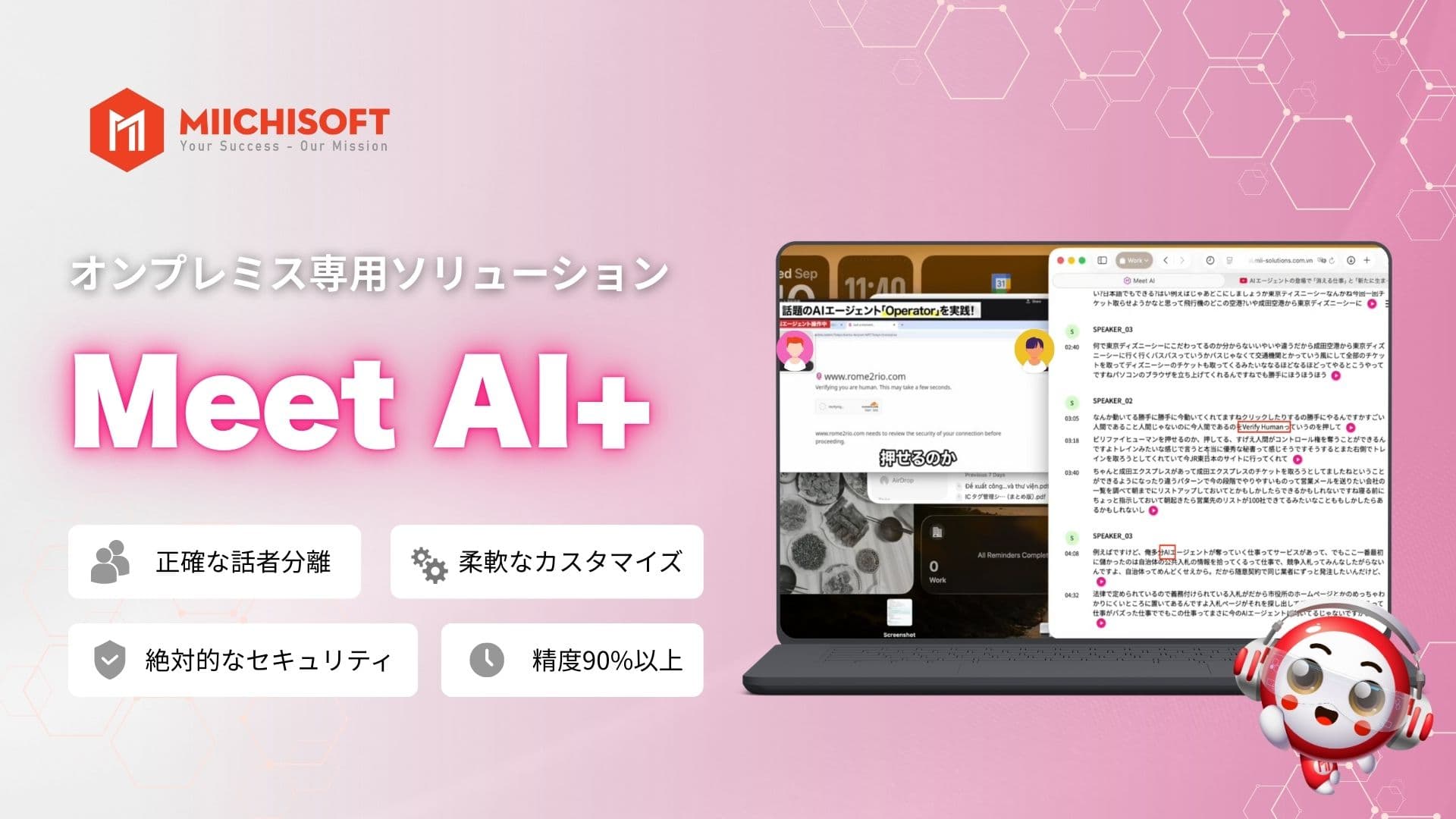
Miichisoft Launched Meet AI+ - AI Meeting Assistant Optimized For On-site Meetings, Reducing Meeting Minutes Creation Time By Up To 90%
6 Criteria for Dify Implementation Vendor Selection you must know! [Free RFP Template]