




Deploying AI chatbots and GenAI applications has become a strategic priority for businesses worldwide. Yet self-managed deployments rarely deliver the results companies expect. According to an NTT Data report, the failure rate for self-implemented AI chatbot projects is estimated at 70 – 85%, with approximately 73% of projects falling short of their initial goals.
Against this backdrop, LLMOps platforms like Dify have become a go-to choice for businesses looking to build AI applications quickly and flexibly. But without a solid deployment strategy and hands-on experience, projects can still run into serious risks including cost overruns, missed deadlines, and underwhelming performance.
That’s exactly why Dify implementation consulting and Dify implementation support services are becoming increasingly essential for organizations that want to get it right the first time.
This article provides a comprehensive guide to the standard Dify implementation consulting process, the criteria for selecting the right implementation partner, and key considerations when working with a consulting firm.
What Is Dify? A Platform Overview Before Exploring Dify Implementation Consulting
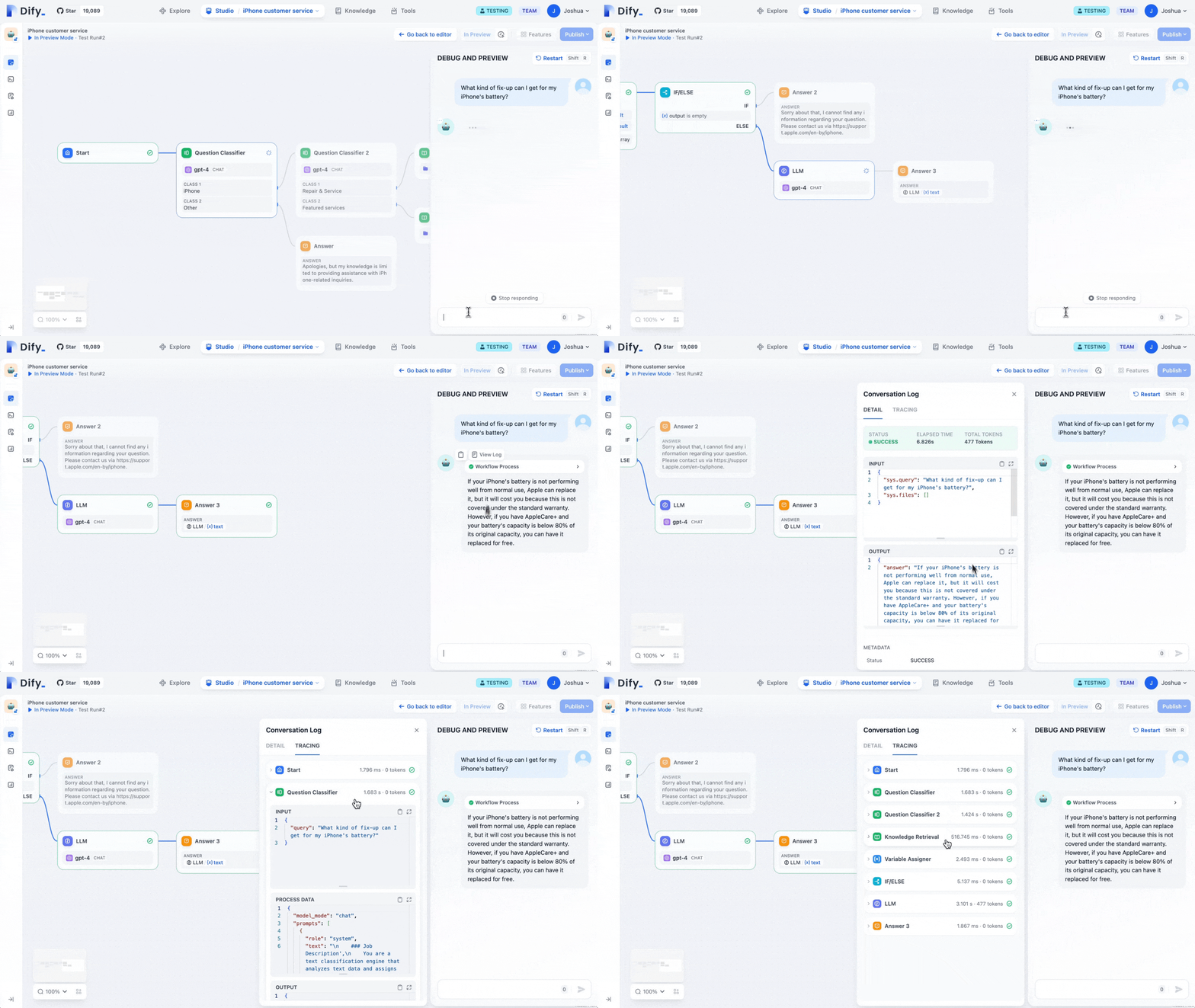
Dify is an open-source LLMOps platform that enables businesses to build and operate AI applications quickly through a low-code/no-code development model. Rather than functioning as a simple Q&A chatbot tool, Dify is designed as a comprehensive AI application development platform, supporting everything from the Proof of Concept (PoC) stage through to production deployment in enterprise environments.
What sets Dify apart is its ability to combine AI application development, workflow management, and large language model operations within a single unified platform. This means businesses can build a wide range of AI applications without having to develop an entire system from scratch.
Three core capabilities explain why more and more businesses are choosing Dify:
- Multi-model AI integration: Easily connect models from OpenAI, Anthropic, Google, or open-source alternatives to optimize cost and performance for each specific use case.
- RAG system development: Allows chatbots to retrieve internal data to generate accurate, context-aware responses rather than relying solely on the model’s general knowledge.
- Workflow automation: Supports the design of multi-step AI workflows with complex logic, ranging from document processing to full business process automation.
Dify Applications in Enterprises
In practice, businesses deploy Dify for a wide variety of purposes. The most common application categories include:
- Internal chatbots: Support employees in quickly retrieving information across departments such as HR, IT, and Sales – reducing time spent searching for documents and handling repetitive inquiries.
- AI assistants for customer support: Automatically respond to customer questions 24/7 across websites, apps, and messaging platforms, improving response speed and reducing the workload on customer service teams.
- AI-powered process automation workflows: Handle ticket classification, order processing, document data extraction, and other repetitive operational tasks automatically.
- AI knowledge bases: Consolidate and make better use of scattered internal knowledge, supporting employee training and enabling faster information sharing across teams.
Learn more: Building An Internal Chatbot With Dify: A Step-by-Step Guide From Setup To Deployment
What Is a Dify Implementation Consulting Service?
Dify implementation consulting service is far more than simply helping install a platform or building a chatbot to specification. At its core, it is a collaborative process that accompanies a business from the initial strategy phase, through architecture design and application development, all the way to stable production operation and a smooth handover to the internal team.
Unlike outsourced developer engagements that execute against a fixed technical brief, consulting focuses on ensuring the project moves in the right direction from day one. The goal is to minimize technical debt, optimize operational costs, and build a solid foundation that supports long-term AI expansion.
Scope of a Dify Implementation Consulting Service
A comprehensive Dify implementation consulting service typically spans multiple phases from strategic direction through to build, training, and post-launch optimization. Each phase plays a critical role in ensuring the project is delivered effectively and can scale sustainably over time.
1. Use Case Consulting and Deployment Strategy
The consultant helps the business identify priority problems and select the use cases most likely to deliver results quickly. Rather than attempting a broad rollout from the start, businesses are guided to begin with smaller, easily measurable objectives, then scale progressively along a clear, structured roadmap.
2. AI and System Architecture Design
This phase demands deep technical expertise and is often the single most important factor in a project’s long-term success. The consultant will:
- Select the appropriate deployment model (Cloud or Self-hosted)
- Choose AI models per task to balance cost and output quality
- Design the RAG architecture (data chunking, embedding, and retrieval)
- Plan for system scalability as user volumes and data grow
3. Environment and Infrastructure Setup
The system is configured from the ground up to ensure security, performance, and cost control:
- Set up access permissions and user authentication
- Configure monitoring and logging
- Establish backup and disaster recovery mechanisms
- Implement operational cost tracking tools
4. Chatbot and AI Application Development
Working from the finalized architecture, the consultant supports:
- Prompt optimization to improve response accuracy and tone
- Development of multi-step AI workflows
- UI customization to meet business requirements
- Comprehensive testing, from core functionality through to system integration
5. Training and Internal Team Handover
This is a critical step that enables the business to operate the system independently after project completion. Training activities typically include:
- System operation and maintenance guidance
- Detailed user documentation
- Hands-on workshops for the internal team
- A post-training support period to address questions as they arise
6. Post-Go-Live Operations Support and Optimization
AI applications require continuous improvement based on real-world usage data. Post-deployment support typically covers:
- Bug fixing and performance optimization
- Prompt and workflow fine-tuning
- Feature updates in response to evolving business needs
- Ongoing operational cost monitoring and optimization
When Should Businesses Use Dify Implementation Consulting Services?
While Dify offers a user-friendly interface and fast deployment capabilities, building and running an AI application in a real production environment still requires substantial expertise in system architecture, data management, and production operations.
Here are some common situations where businesses should seriously consider engaging a Dify implementation consulting service:
- Limited in-house AI expertise: The organization lacks AI engineers or has little hands-on experience with LLMs, RAG, and prompt engineering. Getting the architecture wrong from the start can lead to poor performance, difficult scalability, and high operational costs down the line.
- Complex use cases or system integration requirements: The project requires connecting with CRM, ERP, or other internal systems while handling sensitive data and meeting security compliance standards. These scenarios demand enterprise deployment experience and a deep understanding of system architecture.
- High-stakes production deployments: Applications serving customers or operating at scale need to guarantee uptime, scalability, and continuous system monitoring. Having an experienced consulting partner involved significantly reduces the risk of design errors and minimizes costly revisions after go-live.
Three Common Dify Implementation Consulting Models
Depending on budget and internal technical capacity, businesses can choose from three common Dify implementation consulting models. Each model suits a different level of internal team involvement and a different set of deployment objectives.
1. Full-Service Implementation Consulting
In this model, the consulting firm takes ownership of virtually the entire process from strategy consulting and architecture design through to system development and early-stage operations support. The business only needs to be involved at the level of direction-setting and approval.
- Best suited for businesses without a technical team or those looking to deploy quickly
- Ensures quality and reduces risk from the outset
- Typically the fastest path to a live system
- Higher cost, as the consultant carries the majority of the workload
2. Advisory Consulting
Here, the consultant acts as a technical advisor and reviewer, while the internal team handles the actual development and deployment. The consultant provides architectural guidance, design reviews, best practice recommendations, and technical support when needed.
- Best suited for businesses that already have developers but lack experience with Dify or LLMOps
- Allows the internal team to build knowledge and capability throughout the project
- Lower cost compared to the full-service model
- Requires a reasonably solid internal technical foundation
3. Hybrid Consulting
This model blends implementation and advisory into a single engagement. The consultant designs the overall architecture and builds the most critical components, such as the RAG system or security configuration, while the internal team continues developing the remaining parts under guided support.
- Balances deployment speed, cost, and knowledge transfer effectively
- Delivers fast results while simultaneously strengthening internal capabilities
- Typically well-suited for small-to-medium businesses or growing technical teams
Should Your Business Build In-House or Hire a Dify Implementation Consultant?
The first important decision isn’t which consultant to choose — it’s whether to hire one at all. The answer depends on three key factors: internal technical capability, project complexity, and your desired deployment timeline.
When Should a Business Self-Implement?
Self-implementation is the right fit when the business already has developers with hands-on experience working with APIs, chatbots, or LLM platforms like OpenAI. Deep Dify expertise isn’t required from day one, but a working understanding of prompt engineering, backend integration, and system architecture is essential.
The timeline should be flexible, typically three to six months, to give the team sufficient time to learn and experiment. Use cases well-suited to self-implementation include:
- FAQ chatbots or basic RAG systems built from a single, fixed data source
- Proof-of-concept projects or internal tools with a small user base
- Projects where the primary goal is learning the technology and building internal capability
Advantages
- Saves on upfront consulting costs
- Builds long-term internal expertise
- Full ownership and control over architecture and codebase
Challenges
- Steep learning curve, particularly with RAG and prompt engineering
- Higher risk of early architectural mistakes that lead to costly refactoring later
- Timelines frequently run longer than initially planned
In practice, self-implemented projects typically take three to six months to reach production-ready status, with a success rate of around 60 – 70% for teams without prior experience.
When Should a Business Hire an Implementation Consultant?
Engaging a consultant is the right call when the business needs to move quickly, the project is technically complex, or the team lacks prior experience with Dify and LLMOps.
Situations that point toward hiring a consultant:
- Go-live is required within one to two months
- The project involves integration with enterprise systems such as CRM or ERP
- Multi-step workflows or sensitive data processing are involved
- The deployment is large in scale or carries high security requirements
Key Benefits:
- Significantly reduces time-to-market
- Avoids common design mistakes around RAG, prompt engineering, and security
- Best practices are applied from the very beginning
- Faster ROI, driven by earlier system go-live
To put this in concrete terms: if a chatbot saves 40 working hours per month, the initial consulting investment can pay for itself within six to twelve months.
The Hybrid Approach – Combining Consulting with In-House Development
Many SMEs opt for a hybrid model to strike the right balance between cost and quality. The consultant handles architecture design and the most critical components, while the internal team continues building under structured guidance.
This model works well when:
- The business has in-house developers but limited LLMOps experience
- The goal is to build long-term internal capability, not just deliver a one-off project
- The budget is moderate but risk reduction still matters
A Common Hybrid Workflow
- The consultant designs the architecture and completes the initial platform setup
- The internal team develops the remaining components, with periodic consultant reviews
- The consultant conducts a production readiness assessment before go-live
Benefits
- The internal team learns deeply while still having expert guidance throughout
- Faster delivery than a fully self-managed approach
- Lower risk than going it alone without sacrificing cost control
6 Criteria for Selecting a Dify Implementation Consulting Partner
Before committing to a Dify implementation consulting partner, businesses need a clear evaluation framework, not just a quote comparison or an impressive demo. The table below summarizes the key criteria that help you quickly assess a partner’s real-world capabilities, while flagging the warning signs worth watching out for during the selection process.
Learn more: 6 Criteria for Dify Implementation Vendor Selection you must know! [Free RFP Template]
| Criteria | Core Question to Ask | 🚩 Red Flags to Watch For | |
| ① | ROI Design Capability | Can the partner help you define ROI targets and success metrics before the project begins? | Focuses purely on “build first, measure later” |
| ② | Proven Implementation Experience | Do their case studies include concrete performance data and operational improvements — or just demo screenshots? | Cites NDAs as the reason for sharing zero quantitative results |
| ③ | PoC Support Capability | Can they start with a small PoC to validate value before scaling up? | Pressures you to sign a large contract from the outset |
| ④ | Post-Deployment Support | Do they commit to ongoing optimization and continuous improvement after go-live? | “Handover complete, engagement over” mentality |
| ⑤ | Security and Compliance | Do they have clearly documented security policies and compliance processes? | No specific security documentation or defined procedures |
| ⑥ | System Integration Experience | Have they successfully integrated with ERP, CRM, LINE, or other internal enterprise systems? | Only demonstrates standalone chatbots with no real integration track record |
Dify Implementation Consulting Costs: A Detailed Breakdown
The Cost of Dify Implementation Consulting Services
The cost of Dify implementation consulting refers to what a business pays a consulting partner for architecture design, solution development, and hands-on guidance throughout the deployment process. This fee is not fixed, it varies based on project scope, technical complexity, and the nature of the engagement between both parties.
It’s important to note that consulting fees represent only one part of the total budget. Costs such as the Dify platform subscription, infrastructure, and AI model API usage are billed separately. When evaluating the overall budget, businesses should look at the full deployment lifecycle, not just compare service quotes in isolation.
Learn more: Dify Chatbot Pricing: Complete Guide to Deployment & Operating Costs
Common Dify Implementation Consulting Pricing Models
| Pricing Model | Description | Best Suited For | Key Advantages | Important Considerations |
| Fixed-Price | An all-inclusive quote based on a pre-agreed scope of work | Complete deployment projects with clearly defined goals and scope | Easy to budget for; reduces risk of cost overruns; well-suited for production projects | Scope changes typically incur additional costs; requirements need to be defined with sufficient clarity before work begins |
| Time & Materials | The business pays based on the consulting team’s actual hours worked | Strategy consulting phases; exploratory or early-stage projects where scope is not yet defined | Highly flexible; easy to adjust as the situation evolves | Total cost is difficult to predict if scope shifts frequently; market rate typically ranges from $100–$300 per hour |
| Retainer | A fixed monthly fee in exchange for ongoing support | Long-term operations; system optimization; content updates and performance improvements | Stable budgeting; continuous support; flexible handling of ad hoc needs | Monthly support scope should be clearly defined upfront to avoid misaligned expectations |
Factors That Influence Dify Implementation Consulting Costs
Dify implementation consulting costs are not simply calculated by hours worked. They reflect the depth of strategic involvement the consulting partner brings to the entire solution design process. The same underlying technology platform can lead to very different cost levels depending on the scope and depth of the consulting engagement.
1. Complexity of the Business Problem
The single biggest driver of consulting costs is the complexity of the problem being solved.
If the goal is a basic FAQ chatbot with a narrow scope, consulting work centers mainly on defining content structure and response flows. But if the objective is a multi-workflow automation system integrated into core operational processes, the consulting partner must go much deeper, into business analysis, overall architecture design, and long-term risk assessment.
The more variables a problem involves, the more time is required for analysis and design and consulting costs scale accordingly.
2. Scope and Depth of the Implementation Consulting Service
Unlike standard consulting that stops at recommendations and proposed solutions, implementation consulting extends to supporting the actual deployment, measuring outcomes, and driving continuous improvement.
In many engagements, the consulting partner also contributes to phased rollout planning, ROI estimation, KPI definition, and internal AI operating model design. When the scope expands into strategic advisory and change management, costs will be meaningfully higher than purely technical consulting.
That said, a more comprehensive consulting scope also means greater risk control and better optimization of total project costs over time.
3. Data Readiness and Internal Process Maturity
Consulting costs are also shaped by how standardized the business’s data and processes already are.
When data is well-organized, processes are clearly defined, and documentation is in place, the discovery, analysis, and development phases move much faster. Conversely, when data is scattered and unstructured, or when operational processes lack clarity, the consulting partner will need significantly more time to consolidate and standardize both data and workflows before meaningful progress can be made.
In practice, consulting costs tend to rise when a project involves “defining the problem” as well as solving it.
Key Considerations When Working With a Dify Consultant
Even with a highly capable consulting partner, project outcomes still depend heavily on how well-prepared the business is and how actively it collaborates throughout the deployment process. The following principles help maximize the value of a consulting engagement while reducing the risk of delays or unplanned costs.
1. Define the Business Problem, Goals, and Key Requirements From the Start
Not every business comes to the table with a detailed use case already mapped out — and that’s perfectly normal. Translating a business problem into concrete use cases and designing the right solution is, in fact, a core part of what a consulting partner does. However, for that process to work efficiently, the business still needs to clarify its core problem and non-negotiable requirements at the very start of the engagement.
Key information businesses should prepare includes:
- The specific operational, customer support, or information-handling challenges they are facing
- The outcomes they want to achieve, for example, reducing the load on internal teams, improving response times, or enhancing the user experience
- Critical requirements and constraints such as security standards, compliance obligations, budget limits, and systems that need to be integrated
- Real operational context, so the consulting team fully understands the deployment environment
Working from these inputs, the consulting team will analyze the situation, recommend appropriate use cases, and build a viable deployment roadmap. The clearer the business can articulate its problems and goals, the more precisely the solution will be designed and the lower the risk of out-of-scope issues emerging mid-project.
2. Establish a Clear Communication and Feedback Process
Inconsistent communication is one of the most common reasons projects run over schedule or require repeated revisions.
Businesses should:
- Set up structured weekly check-ins with clearly defined agendas
- Assign a single primary point of contact with the authority to make decisions and approvals
- Provide feedback on demos and documents within two to three business days
- Give specific, example-based feedback rather than vague general comments
A well-defined communication process reduces revision cycles and accelerates the overall deployment timeline.
3. Allocate Internal Resources and Stay Actively Involved
A common misconception is that once a consulting firm is hired, the business can hand everything over and step back. In practice, active internal participation is one of the most important factors in determining outcome quality.
Key internal roles include:
- Subject matter experts to validate content and data accuracy
- The IT team to handle system access, permissions, and integration support
- Business unit representatives to participate in testing and provide user experience feedback
During the deployment phase, businesses should expect to dedicate approximately five to ten hours per week to meetings, testing, and coordination. The most effective mindset is one of co-building the solution, not simply outsourcing it.
4. Plan for Knowledge Transfer From Day One
Knowledge transfer should not be left until the end of the project. Last-minute, intensive handover training rarely gives internal teams enough time to develop a full understanding of the system.
Businesses should:
- Identify who will own system operations post-deployment as early as possible
- Involve the internal team throughout the project, not just at handover
- Document key design decisions and the reasoning behind solution choices
- Ask questions actively throughout the engagement, don’t wait for a formal training session
The goal is not simply to know how to use the system, but to understand how to operate and optimize it over time.
5. Maintain Realistic Expectations and Respect the Deployment Process
AI and automation deliver significant value but they are not plug-and-play solutions. Projects typically need to be rolled out in stages and refined progressively based on real-world feedback.
A few important principles to keep in mind:
- An MVP is the minimum viable version needed to validate value, not a finished product
- Take the consulting team’s recommendations seriously; they are grounded in practical deployment experience
- Avoid attempting to launch every use case at once from the very beginning
- Do not skip steps in a deployment process that has been carefully designed for a reason
The most successful projects are those built on close collaboration and the flexibility to address issues as they arise, rather than expecting everything to go perfectly from day one.
Dify Implementation Consulting Services at Miichisoft
Miichisoft provides Dify implementation consulting services for businesses looking to bring AI into their operations. Rather than simply delivering technical services, we aim to be a long-term partner, starting from business problem analysis and solution design, through to system deployment, post-launch optimization, and scaling.
With hands-on experience across more than 50 real-world AI chatbot projects, our team understands the common challenges that arise in enterprise environments and knows how to structure the right deployment approach from the very beginning.
We offer flexible service packages designed to match each stage of the Dify deployment journey, from rapid PoC and full production rollout through to long-term operations and optimization. Each package comes with a clearly defined scope of work, transparent pricing, and a focus on delivering genuine, measurable business value.
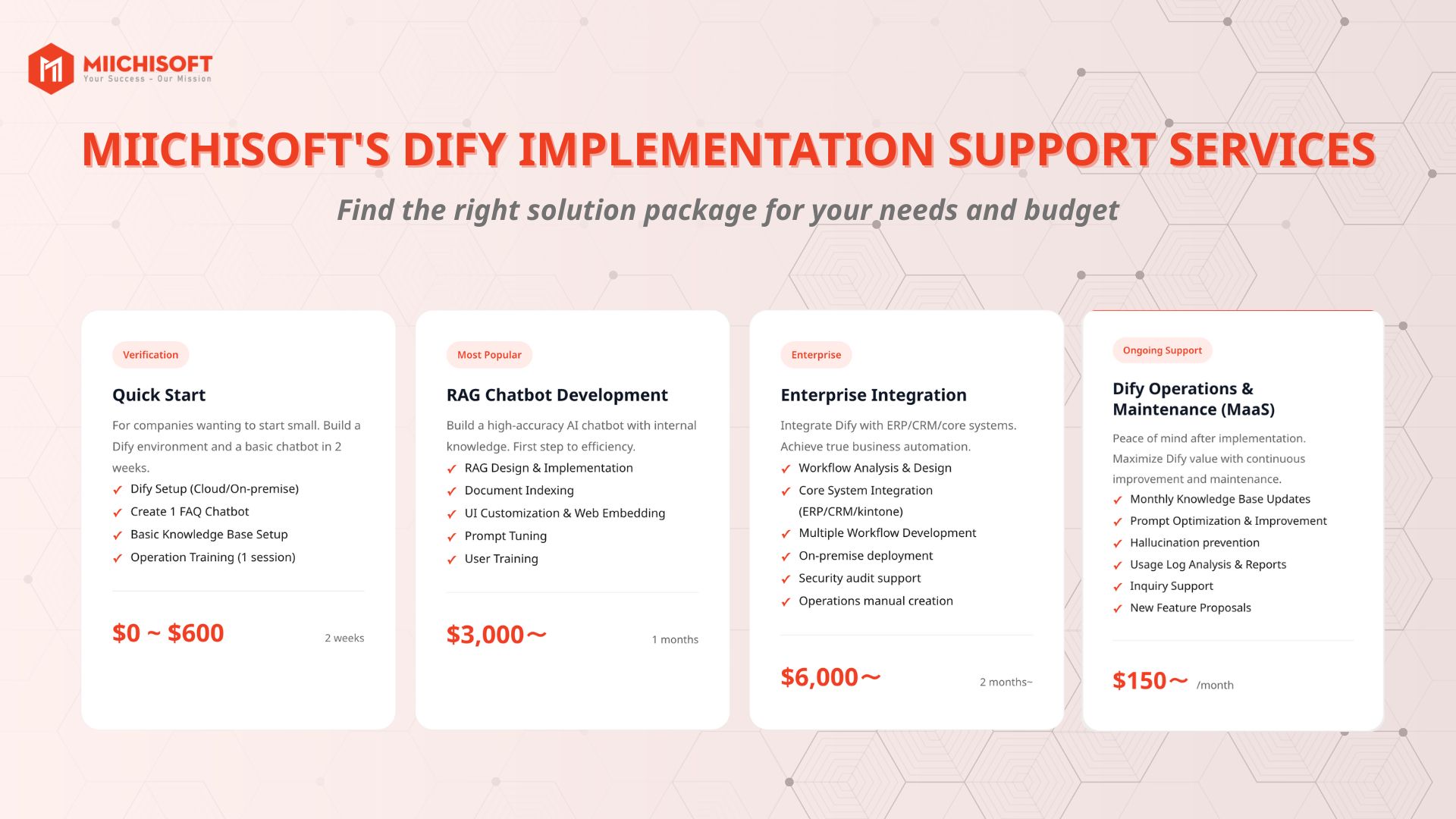
If your business is considering a Dify deployment or wants to assess whether it’s the right fit for your current challenges, a free consultation is a natural first step. It’s a no-obligation conversation to explore your needs, pain points, and deployment direction together.
Conclusion
Deploying an AI chatbot with Dify is more than a technology choice, it is a strategic decision that directly affects operational efficiency and long-term ROI. Success doesn’t come from using the most sophisticated technology available. It comes from correctly identifying the right problem to solve and deploying in a way that matches your organization’s real capabilities.
Dify is making AI application development more accessible for a growing number of businesses. Whether you choose to self-implement or work with a consulting partner, the most effective approach remains the same: start small, validate quickly, and continuously optimize based on real usage data.
If you are exploring how Dify might work within your organization, speaking with a team that has genuine deployment experience can help you see the path forward much more clearly.
Miichisoft is always happy to share our perspective and practical insights to support you during the evaluation and discovery phase, with no strings attached.
FAQ
Q1: How do I know whether my business should self-implement Dify or hire a consultant?
The decision comes down to three factors: internal technical capability, business timeline, and use case complexity.
If your team has developers familiar with APIs or LLMs, your timeline is flexible (three to six months), and your use case is straightforward, a FAQ bot or basic RAG system, self-implementation is viable and helps your team build real experience.
If you need to go live within one to two months, lack in-house AI expertise, or the project involves complex integrations and security requirements, a consultant will reduce risk and accelerate time-to-production.
A practical benchmark: internal effort for a production-ready chatbot typically runs 300–600 hours. Compare that personnel cost against consulting fees to make the call.
Q2: What is the typical cost range for Dify implementation consulting?
Costs range from a few hundred USD for simple PoC projects to over $30,000 for complex enterprise systems.
Key cost drivers include use case complexity, number of integrations, data readiness, customization requirements, and timeline urgency.
Beyond consulting fees, budget separately for Dify Cloud subscription (if using SaaS), infrastructure for self-hosted deployments, and LLM API usage. Always clarify what’s included in a quote upfront to avoid surprises.
Q3: How long does a Dify deployment typically take?
- PoC or Quick Start: 1–2 weeks
- SME production-ready chatbot: 4–8 weeks
- Enterprise with multiple integrations: 8–16 weeks
Timeline is most affected by data quality, stakeholder responsiveness, number of integrations, and testing requirements. A common approach is to deploy an MVP first, then expand in phases.
Q4: After deploying with Miichisoft, will my business be locked into a vendor dependency?
Generally, no – provided the project is handed over with full documentation, training, and system access.
Regardless of vendor, your contract should cover ownership of chatbot configuration and data, operational documentation, a post-handover transition support period, and no technical lock-in. Ongoing support services are available, but should always be optional – not mandatory.
Q5: How does Miichisoft’s deployment process differ from standard consulting?
The core structure is the same: discovery → design → development → testing → handover.
The difference is in execution: we prioritize use cases with the fastest ROI first, run weekly demos for stakeholder visibility, and embed training throughout the project rather than saving it for the end, so your team is ready to operate independently from day one.
![[Dify Case Study] Dify AI Contract Review Chatbot in 2 Minutes – Standardized to Internal Compliance Requirements](https://miichisoft.com/wp-content/uploads/2026/02/difyai-2-1.jpg)
![6 Criteria for Dify Implementation Vendor Selection you must know! [Free RFP Template]](https://miichisoft.com/wp-content/uploads/2026/02/dify-vendor-jp-1.jpg)