




AI chatbots are expanding rapidly across enterprises, especially in the Japanese market. According to Imarc’s forecast, Japan’s chatbot market could reach $2.04 billion by 2033, with a compound annual growth rate of 19-20%. These numbers reflect the surging demand for automated customer service and streamlined internal operations.
Dify has emerged as a leading platform in this space. Businesses appreciate its rapid deployment, flexibility, and versatility across different use cases. But successful implementation starts with understanding the complete picture of Dify chatbot pricing. What costs are actually involved? Where do expenses arise? And how can you optimize your budget from the start?
This guide breaks down the complete Dify chatbot pricing structure, covering platform fees, infrastructure requirements, and real-world operational costs.
Understanding Dify Chatbot Fundamentals
Dify is an open-source platform for building AI chatbots and applications using a no-code/low-code architecture. Rather than focusing solely on question-answer interfaces, Dify functions as a comprehensive “deployment framework” for AI applications. This allows businesses to build chatbots deeply integrated with their internal data and workflows.
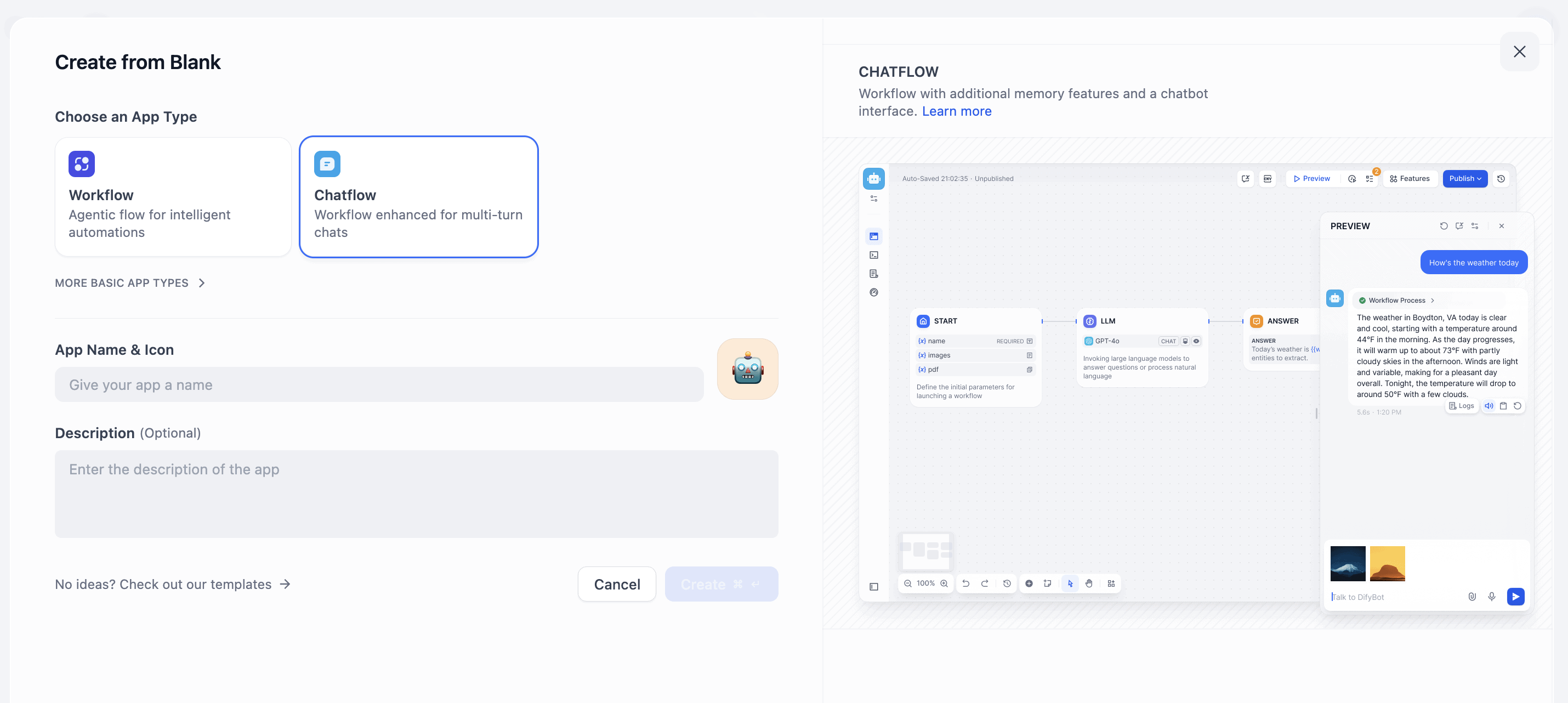
This approach makes Dify versatile across various business scenarios, from simple to complex. Common Dify chatbot implementations include:
- Basic FAQ chatbots to handle repetitive questions
- RAG chatbots that search internal documents like PDFs, Word files, FAQs, Notion, or Google Drive
- Internal support chatbots for departments like HR, IT helpdesk, or Sales
- Multi-channel customer service chatbots on websites, apps, or Zalo OA
- Complex AI workflows integrated with CRM, ERP, or internal software systems
These scenarios share common requirements: chatbots must provide accurate responses based on company data, scale easily, and deploy quickly. That’s why Dify is typically positioned as a platform focused on data-driven chatbots with rapid deployment and reasonable costs. It’s ideal for businesses seeking real value from chatbots rather than stopping at the pilot phase.
Understanding these capabilities is essential when evaluating Dify chatbot pricing, as your specific use case directly impacts implementation and operational costs.
Learn more: Building An Internal Chatbot With Dify: A Step-by-Step Guide From Setup To Deployment
Complete Breakdown of Dify Chatbot Pricing
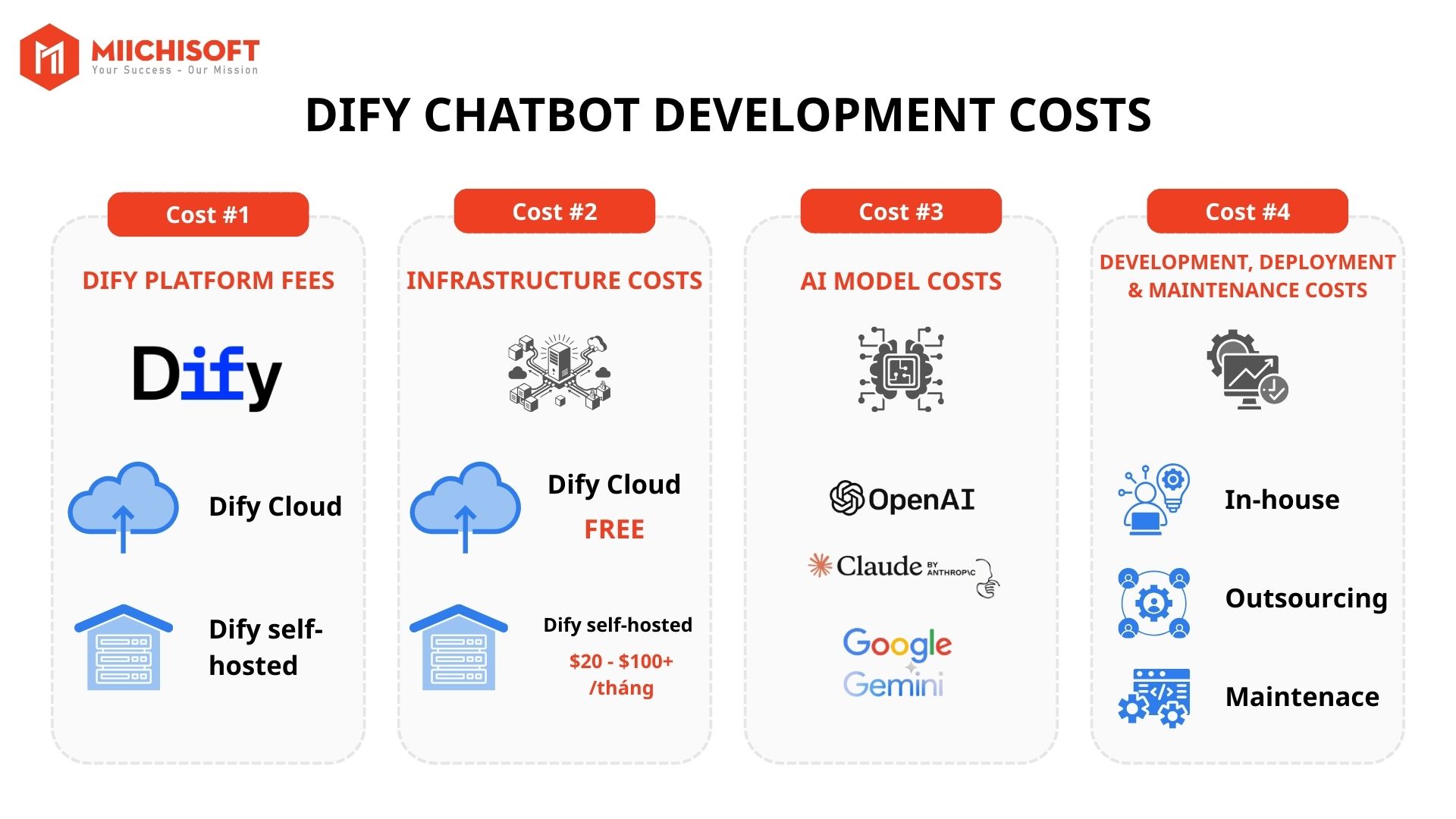
Building a Dify chatbot from scratch involves four main cost categories:
- Dify platform costs
- Infrastructure costs
- AI model costs
- Development, deployment & maintenance costs
Understanding each component of Dify chatbot pricing is crucial for accurate budget planning. Let’s examine what each category includes and where expenses typically arise.
Cost #1: Dify Platform Fees
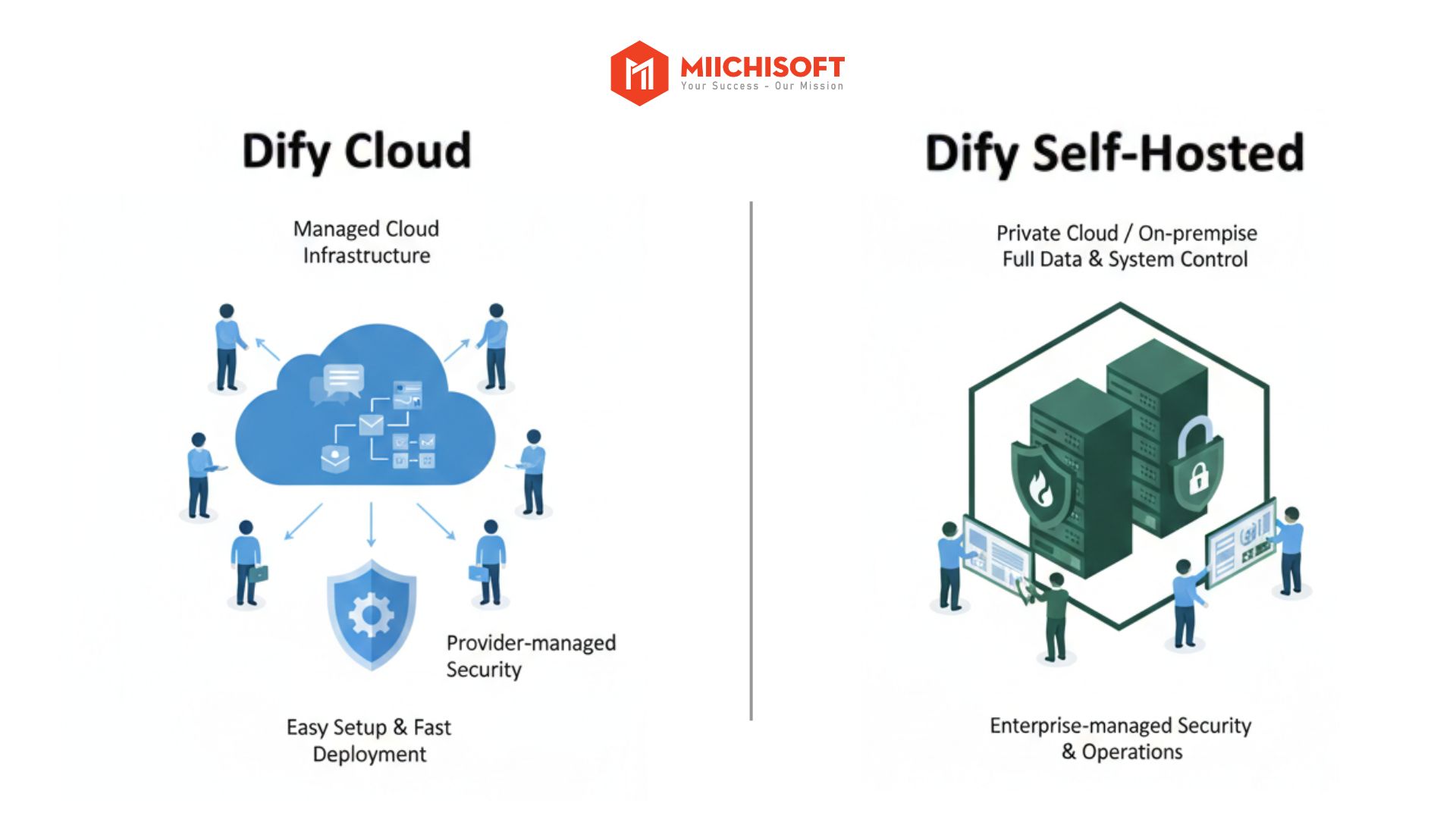
Dify currently offers two main deployment options:
- Dify Cloud (SaaS)
- Dify Self-Hosted
Your choice directly impacts both initial setup costs and long-term operational expenses.
Dify Cloud Pricing
With Dify Cloud, you pay monthly or annual subscription fees. The biggest advantage is zero infrastructure management, no server maintenance, system updates, or version upgrades to worry about.
Dify Cloud offers three main tiers suited to different business stages:
| Plan | Cost | Best For | Key Strengths | Limitations |
| Sandbox | Free | Individuals, initial testing | Free exploration of Dify, quick setup | 200 message credits (one-time only), not suitable for long-term use |
| Professional | $59/month $590/year | Small teams of 2-3, PoC or internal pilots | Low cost, sufficient for real use case testing | 5,000 credits/month runs out quickly with regular use |
| Team | $159/month | SMEs, full production deployment | High message credits and user capacity, low per-user cost | Requires usage monitoring to avoid exceeding quota with high-traffic chatbots |
Self-Hosted
The second option for building your Dify chatbot is deploying Dify on your own infrastructure.
Minimum technical requirements for Dify self-host include a server with 2 CPU cores, 4GB RAM, 10GB free SSD, and Docker installed. This configuration works for testing environments or simple chatbots. For production deployments with multiple concurrent users and large document volumes, you’ll typically need much more, often 8-16GB RAM and additional CPU cores.
Self-hosting is ideal when you have experienced DevOps or SysAdmin teams, when data security requirements are critical (like financial or healthcare organizations), or when your project spans 2+ years and you want to optimize long-term costs.
Cost #2: Infrastructure Costs
With Dify Cloud, businesses pay virtually no additional infrastructure costs. All server, database, and storage needs are handled by Dify and included in the monthly subscription fee. This allows businesses to focus entirely on building and operating their chatbot without worrying about system management.
When choosing self-hosted Dify, however, businesses must cover their own infrastructure expenses. These costs revolve around three main components: servers, data storage, and basic operational overhead.
For a small internal chatbot serving a few use cases and under 1,000 users, businesses can use standard cloud servers from providers like AWS, Google Cloud, or Azure. Common configurations at this scale typically cost $20-40 per month.
When your Dify chatbot scales to more users or needs to process large document volumes for retrieval (RAG), infrastructure costs increase accordingly. At this stage, total server costs usually range from $40-100 per month, depending on usage and cloud provider.
Beyond server costs, businesses must also account for data storage expenses, including:
- Knowledge base document storage
- Database for chatbot information
- Regular data backups
Overall, Dify self-hosted infrastructure costs are relatively predictable and not excessive compared to development or AI model costs. However, businesses should note that self-hosting requires additional resources for system operation and maintenance, tasks that Dify Cloud handles automatically.
Learn more: [Differences between Dify Cloud and Self-hosted Dify]
Cost #3: AI Model Costs (OpenAI, Claude, Llama..
AI model costs are the most underestimated expense of Dify chatbot pricing plan. Dify serves as the chatbot building platform, but actual response capability depends on AI models like GPT, Claude, or Gemini. Businesses must pay separately for these models, and this often becomes the largest monthly operational expense.
AI providers charge based on usage volume. Simply put, every user question and chatbot response incurs a cost. Expenses scale with question length, response length, and the amount of data the chatbot references. The more your chatbot is used, the higher your AI costs.
Pricing varies dramatically between models. Premium models like GPT-4 or Claude Opus deliver superior response quality but cost more, while lighter models like GPT-3.5, Claude Haiku, or Gemini Pro are significantly cheaper and still suitable for simple scenarios like FAQs or information lookup.
In real-world projects, LLM API costs for Dify chatbots typically range from $50-1,500 per month. Internal chatbots or pilots usually cost just tens to hundreds of dollars, but public-facing chatbots with many users require higher budget allocations to avoid cost overruns.
These costs can be significantly optimized with proper design from the start. The most effective approach is selecting the right model for each question type, rather than using one expensive model for everything. Additionally, businesses can reduce costs by:
- Using lighter models for simple questions
- Leveraging cache for repetitive queries
- Writing concise prompts without redundancy
Cost #4: Development, Deployment & Maintenance
Beyond platform and AI model fees, businesses must account for Dify chatbot pricing plan. While Dify follows a no-code/low-code approach, building an enterprise-ready chatbot still requires time, resources, and implementation expertise.
In-House Development
For simple Dify chatbots like FAQs or RAG using a few internal documents, deployment typically takes 2-6 weeks. More complex chatbots with workflows and multiple system integrations can require 2-4 months.
Industry benchmarks show AI chatbot development costs ranging from $12,000 to $85,000, depending on complexity and security requirements. Markets with lower labor costs may reduce total expenses, but the gap between chatbot types remains similar.
Partnering with Implementation Specialists
If your business lacks suitable technical resources or wants to ensure rapid deployment with consistent quality, hiring a Dify implementation support partner is a common choice.
Reference pricing:
- Simple chatbots: $3,000 – $10,000
- Mid-tier chatbots (AI, RAG, integrations): $10,000 – $40,000
- Enterprise solutions: $60,000+
Dify Chatbot Maintenance & Operations
Dify chatbots require ongoing content updates, prompt optimization, and performance monitoring after go-live. In practice, maintenance costs typically run 10-30% of initial development costs per month, depending on usage levels and operational model.
Choosing the Right Dify Plan for Your Business Size
After understanding all components in Dify chatbot pricing plan, the next step is selecting the right Dify plan for your business scale and deployment stage. The highest-tier plan isn’t always the best choice – what matters is finding the right fit to avoid budget waste.
Individual / Testing Phase
If you’re an individual developer or business in the chatbot idea testing phase, Dify’s free Sandbox plan is a sensible starting point. This stage suits platform familiarization and chatbot feasibility validation.
Total costs typically remain very low, from $0-600, depending on whether you self-deploy or need initial setup support.
Small Teams (2-3 People) in Active Operation
When your Dify chatbot is being actively used by a small team, the Professional plan ($59/month) fits well. This tier adequately supports stable operations at small scale. Total costs at this stage typically include monthly Dify fees and usage-based LLM API costs, with moderate initial setup expenses.
Department-Level Deployment / SMEs
This is the most common deployment stage. For teams of 10-30 people, the Team plan ($159/month) offers better cost efficiency when distributed across users.
Businesses typically invest more in building robust RAG chatbots to ensure accuracy and scalability. Total setup costs usually start at $3,000+, with monthly operational costs covering Dify, LLM API, and potentially operational support packages.
Company-Wide Deployment / Enterprise
For large organizations with high security, compliance, and system integration requirements, Dify’s Enterprise plan is the appropriate choice. Initial deployment costs can range from $6,000-20,000+, depending on complexity.
Monthly operational costs typically run several thousand dollars, covering platform fees, LLM API, and dedicated operational support.
Maximizing Cost Efficiency (ROI) When Deploying Dify Chatbots
Once your Dify chatbot is operational, the most important question is: does this investment deliver proportional value? To answer this, businesses need clear ROI quantification rather than relying on gut feelings.
Quantifying Dify Chatbot Value
Chatbot ROI typically comes from three main sources:
- Reduced costs from handling repetitive questions for departments like customer service, HR, or IT
- Indirect revenue gains through improved customer experience and 24/7 response availability
- Increased internal productivity when employees access information faster and spend less time searching for documents
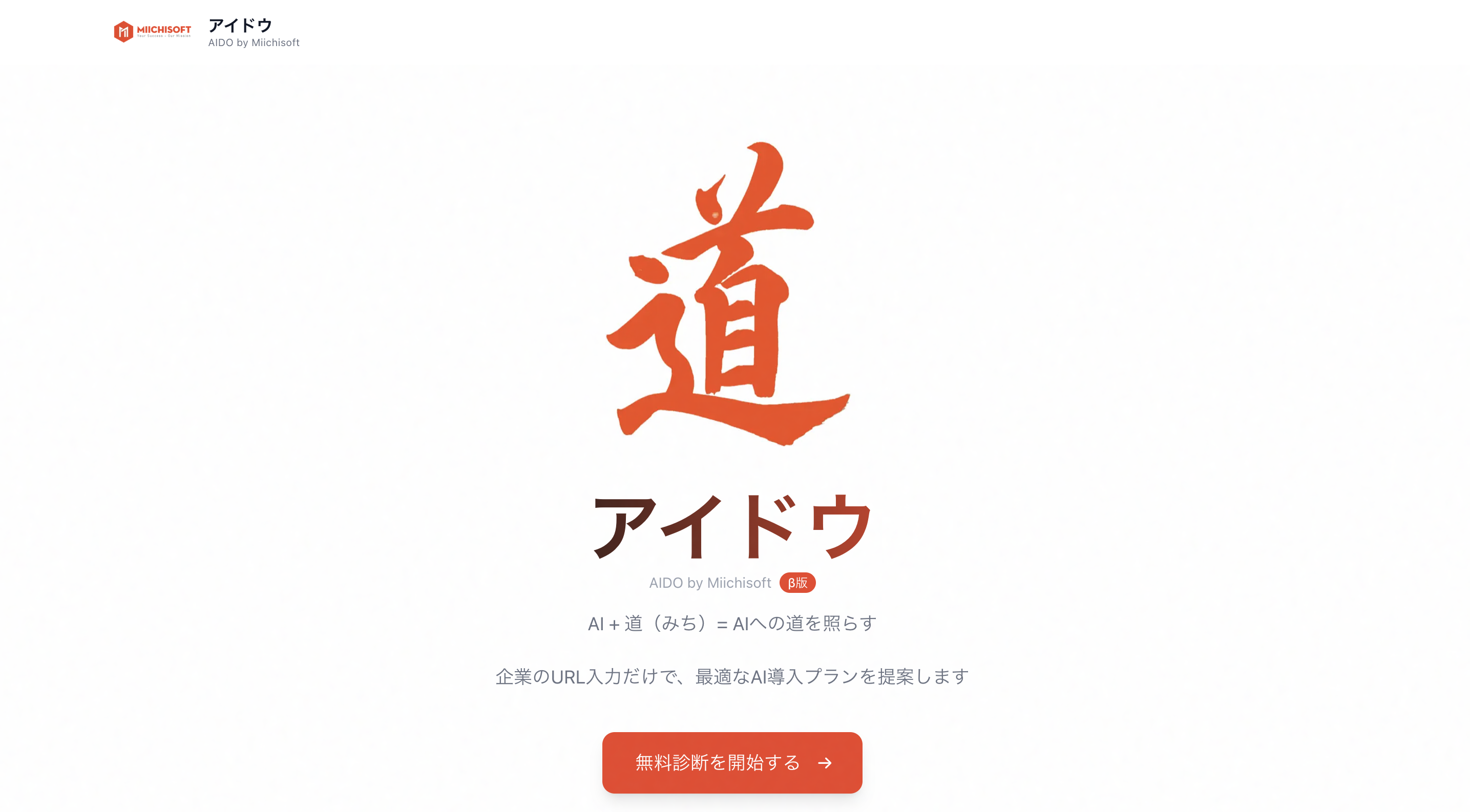
If you’re still struggling with calculating ROI for your Dify chatbot, try AIDO – the free AI potential assessment tool developed by Miichisoft. Simply input your company information and current pain points, and AIDO automatically suggests a detailed AI implementation roadmap with specific ROI calculations-completely free.
Best Practices for Cost Optimization
To reduce costs while maintaining Dify chatbot quality, businesses should:
- Monitor message credit usage and only upgrade Dify plans when truly necessary
- Choose the right LLM model: powerful models for complex tasks, lighter models for FAQs
- Optimize prompts to reduce unnecessary token consumption
- Use caching for repetitive questions to minimize API calls
Common Mistakes and Solutions
Several common issues lead to lower-than-expected ROI:
- Sudden LLM API cost spikes from lengthy prompts or unlimited output
- Over-purchasing Dify plans relative to actual user count
- Inaccurate chatbot responses from lack of tuning and knowledge base updates
- No usage log analysis, preventing chatbot improvement based on user behavior
By investing just 20-30 minutes weekly to review logs and optimize the most frequently asked questions, businesses can significantly improve Dify chatbot effectiveness without increasing budget.
Dify Chatbot Implementation Support Services from Miichisoft
Miichisoft specializes in consulting and providing Dify chatbots implementation support service for businesses. Rather than a “build fast and move on” approach, Miichisoft functions as a Growth Partner, helping businesses clarify their objectives, create budget-appropriate implementation roadmaps, and scale chatbots over time.
Miichisoft’s differentiator lies in its end-to-end approach: from use case consultation and chatbot/RAG architecture design to technical deployment, post-launch operational support, and ongoing optimization. This proves especially valuable for businesses deploying chatbots for the first time or seeking long-term ROI assurance.
Dify Implementation Service Packages
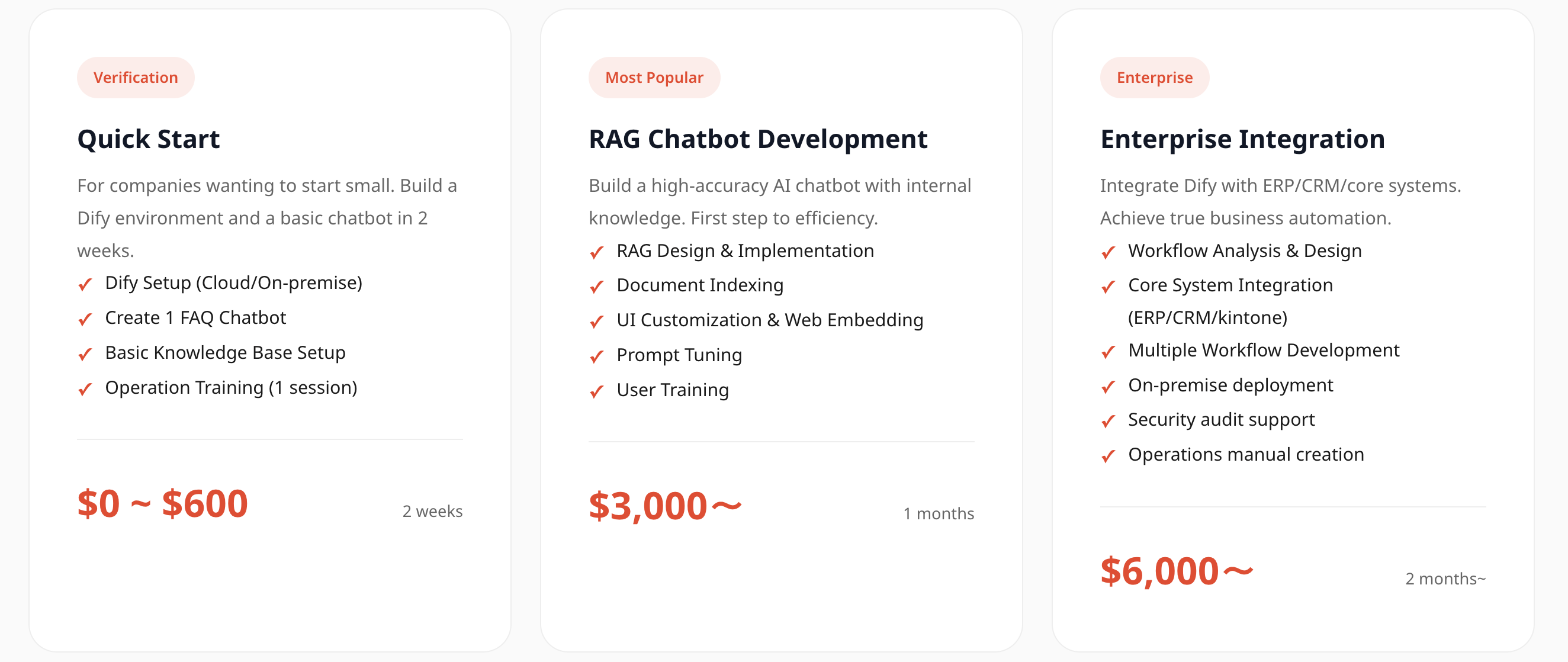
Miichisoft offers flexible service packages suited to different deployment stages:
- Quick Start: Rapid PoC support to help businesses evaluate Dify’s suitability before major investment
- RAG Chatbot Development: Build production-ready chatbots for internal data retrieval
- Enterprise Integration: Deploy chatbots with deep business system integration and high security requirements
- Operations & Maintenance (MaaS): Continuous post-deployment operational support, optimization, and improvement
Comparison: Building Dify Chatbots In-House vs. Partnering with Miichisoft
| Criteria | In-House Development | Miichisoft Services |
| Timeline | 3-6 months | 2 weeks – 2 months (50% faster) |
| Costs | Developer salaries + trials + mistakes | Fixed, transparent |
| Technical Risk | High (lack of experience) | Low (proven track record) |
| Quality | Team-dependent | Best practices guaranteed |
| Post-Launch Support | Self-managed | Warranty + MaaS |
| Learning Curve | Self-research required | Knowledge transfer included |
The decision between in-house development and hiring Miichisoft depends on several factors. Build in-house if you have developers with AI and chatbot skills, can allocate 3-6 months, want to learn and build internal expertise, or have a relatively simple project.
Conversely, partner with Miichisoft if you need rapid deployment within 2-4 weeks, lack Dify or RAG expertise, want quality assurance from day one, or require long-term support.
Conclusion
Successfully deploying a Dify chatbot isn’t just about choosing the right tool, it’s about proper cost preparation and implementation strategy. Three core points businesses should remember: understand all cost categories and their proportions, don’t overlook hidden costs (especially LLM API and maintenance), and deploy in phases rather than making large upfront investments.
Equally important is continuous cost efficiency measurement. Businesses should establish monitoring from day one, track usage metrics and costs regularly, and adjust strategies as needed. Dify chatbots aren’t “set-and-forget” systems – they require ongoing improvement to maintain value.
When you need clearer roadmaps or in-depth consultation, engaging with experienced implementation partners like Miichisoft helps you avoid costly mistakes and build effective Dify chatbots from the start.
Contact Miichisoft today for free consultation tailored to your specific business challenges.
FAQ
Q1: How far can the free Sandbox plan take you?
The Sandbox plan provides 200 one-time message credits (non-renewable monthly), 50MB knowledge base storage, and 15-day log retention. This plan only suits testing Dify for a few weeks, it’s not sufficient for production use. Once you exhaust the 200 credits, you’ll need to upgrade to a paid plan to continue.
Q2: How do you manage LLM API costs?
There are four main ways to control LLM API expenses:
- Set up budget alerts on OpenAI or Anthropic dashboards to receive warnings when approaching limits
- Monitor daily token usage to detect cost spikes early
- Use Dify’s caching feature to reduce API calls for repetitive questions
- Choose the right model for each task—use cheaper models for simple queries, reserve expensive ones for truly complex needs
Q3: Self-host or Cloud – which is cheaper?
Cloud is typically cheaper short-term, costing only $59-159 monthly for the platform. Self-hosting can become more cost-effective long-term if you have existing technical teams and projects spanning 2-3+ years. However, you must factor in personnel costs for system operation and maintenance. When fully accounting for labor, Cloud usually proves more cost-effective for most SME businesses.
Q4: Does Miichisoft provide post-deployment support?
Yes. Miichisoft offers 3-12 month warranties depending on your service package. We also provide MaaS (Maintenance as a Service) at $150/month, which includes knowledge base updates, prompt optimization, log analysis, and technical support. You can reach us via hotline or email. We provide comprehensive training and Vietnamese documentation so your team can self-operate afterward.
Q5: Can I self-operate after the contract ends?
Absolutely. Miichisoft transfers complete source code (if custom-developed), detailed technical documentation, and provides team training and onboarding support. You can then maintain everything independently or continue with our MaaS package at much lower cost than hiring a full-time engineer.