


![[Case Study Dify] AI ERP Query Bot Using Natural Language - Retrieve data in seconds](https://miichisoft.com/wp-content/uploads/2026/03/case-study-dify-chatbot-ai-truy-van-erp-bang-ngon-ngu-tu-nhien-tim-kiem-du-lieu-chi-trong-vai-giay-1.jpg)


Enterprise Resource Planning (ERP) systems store critical operational data such as inventory levels, sales performance, and customer transaction history. However, retrieving information from ERP systems is often time-consuming and inefficient, directly impacting customer responsiveness and slowing down the sales closing process.
In this Dify case study, we introduce an AI ERP Query Bot that enables natural language data retrieval. Acting as an intelligent middleware layer, the chatbot allows business teams to access ERP data with a single reducing response time from several minutes to just a few seconds and significantly improving operational efficiency.
https://youtu.be/qh2dqbu-KOk?si=SMIrBl0GCS4k6osv
Why is ERP data retrieval slower than expected?
Although ERP systems store comprehensive operational data, accessing the right information is rarely instantaneous. In practice, data retrieval from ERP often takes longer than expected due to structural and functional limitations. Below are two key reasons why ERP data queries tend to be slow.
Data access typically requires multiple steps
ERP systems manage multiple business functions, such as sales, inventory, accounting, procurement, and production through separate modules. Each module has its own data structure, workflows, and user interface.
To retrieve a specific piece of information, users must log into the system, identify the correct module, enter precise data codes, and configure multiple filtering conditions before viewing results. If further analysis is required, they often need to export reports and process the data manually.
As a result, a seemingly simple information lookup can involve five to six sequential steps. This multi-step workflow prevents real-time information access and negatively impacts business scenarios that require immediate responses.
ERP systems cannot retrieve aggregated data in a single query
ERP systems are designed around functional modules rather than cross-functional insights. Sales data, inventory levels, and accounts receivable are typically stored in separate modules.
When users ask aggregated business questions – such as “How much outstanding balance does Customer A have, and what is their total sales revenue this year?” or “How much inventory is left for Product B, and are there pending outbound orders?”. The ERP system cannot provide a direct answer in a single query or a unified view.
Instead, users must manually collect and consolidate data from multiple modules. This manual aggregation significantly extends retrieval time and slows decision-making, especially in time-sensitive business operations.
The Solution: A Natural Language AI ERP Query Bot Built on Dify’s No-Code/Low-Code Platform
To turn ERP from a bottleneck into an asset, businesses need a middleware layer that enables fast, intuitive data retrieval.
To address this challenge, Miichisoft leveraged the Dify platform to develop an Natural Language AI ERP Query Bot using the Dify platform. The chatbot allows users to retrieve ERP data instantly without interacting directly with the ERP system interface.
https://youtu.be/qh2dqbu-KOk?si=SMIrBl0GCS4k6osv
Users simply enter a question and receive the retrieved data within seconds. They can also ask follow-up questions seamlessly, without restarting the query process from scratch.
How the AI ERP Query Bot Works
This solution does not replace the ERP system, rewrite existing applications, or modify core system structures. Instead, it operates as an intelligent middleware layer built on three key mechanisms:
- Understand the question and identify the right ERP data source
The chatbot receives the user’s question and automatically analyzes the business intent behind it. Based on this analysis, it identifies the relevant ERP modules, data tables, or specific fields required to answer the query.
Users do not need to know where the data is stored, remember data codes, or understand the ERP system’s internal structure.
- Retrieve and consolidate data across relevant modules
Once the correct data sources are identified, the chatbot retrieves information from relevant ERP modules such as sales, inventory, and accounting. If the question involves multiple business domains, the chatbot automatically aggregates the data into a single response.
As a result, complex questions like “What is Customer A’s sales revenue this year and their current outstanding balance?” can be answered in a single query.
- Process and respond in natural language
After retrieving the data, the chatbot transforms raw ERP outputs into clear, easy-to-understand natural language responses. Users can also request the results in structured formats, such as tables, instead of reviewing large volumes of raw data.
With this chatbot, users no longer need to navigate across multiple ERP modules. They can simply ask questions and receive the information they need instantly.
What Makes the Dify AI ERP Query Bot Different
Unlike conventional chatbots that rely on static or preloaded datasets, the AI-powered ERP query chatbot is directly connected to the enterprise’s internal ERP system. This creates three key differentiators:
- Powered by real-time ERP data
The chatbot does not rely on sample data or simulated information. Every response is retrieved directly from the enterprise ERP system through secure API connections.
This ensures that all answers accurately reflect real-time business metrics, including sales performance, inventory levels, accounts receivable, and other operational indicators.
- Flexible deployment without modifying the existing ERP system
Businesses do not need to rewrite their ERP system, change core data structures, or disrupt existing workflows. The chatbot functions purely as a fast query layer on top of the current ERP environment.
- Enterprise-grade security and full data control
The solution can be deployed in private cloud or on-premise, ensuring that all business data and internal standards remain within the organization’s infrastructure.
This approach allows enterprises to maintain full control over their data while meeting strict security, compliance, and governance requirements.
How the Natural Language AI ERP Query Bot Supports Your Teams
Dify case study 1 – Finance: Monitoring Receivables and Cash Flow
In B2B enterprises, customer receivables are typically tracked within the ERP system but are not always reviewed daily.
Finance teams often need to filter reports, export files, and manually consolidate data to identify overdue customers, outstanding balances, and changes in receivables. This process is time-consuming and heavily dependent on technical ERP operations.
The consequences:
- Overdue receivables may not be detected in time.
- Finance staff spend excessive time on manual operations instead of financial analysis.
How the AI ERP Query Bot helps:
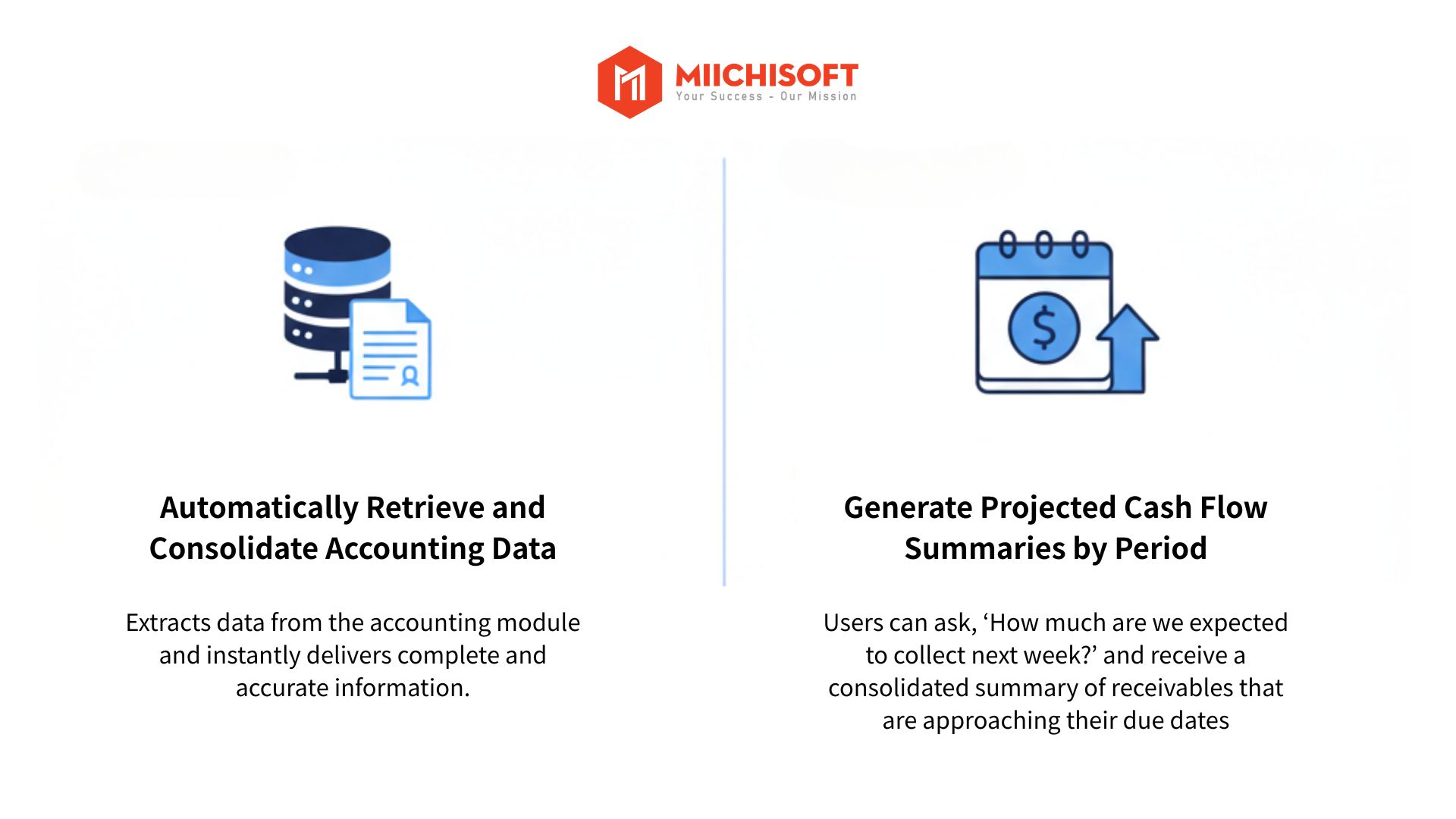
- Automated retrieval and consolidation of accounting data
Users can simply ask questions such as “How much outstanding balance does Company ABC have, and is it overdue?” The chatbot automatically retrieves data from the accounting module and returns complete results instantly.
- Forecasted cash flow by period
Users can ask “How much cash is expected to be collected next week?” and receive a consolidated view of upcoming receivables approaching their due dates.
Dify case study 2 – Production: Spotting Material Shortages Before Orders Fall Behind
In manufacturing environments with multiple urgent orders running in parallel, managers need to quickly determine whether raw materials for the upcoming production period are sufficient, and which orders may be at risk due to material shortages.
However, this information is typically distributed across multiple ERP modules, such as inventory, bill of materials, and delivery planning.
The consequences:
- Material shortages are often discovered only after production has started.
- Orders must be rescheduled or delayed while waiting for materials.
- Enterprises incur additional costs from urgent purchases, overtime, and potential damage to customer trust.
How the AI ERP Query Bot helps:
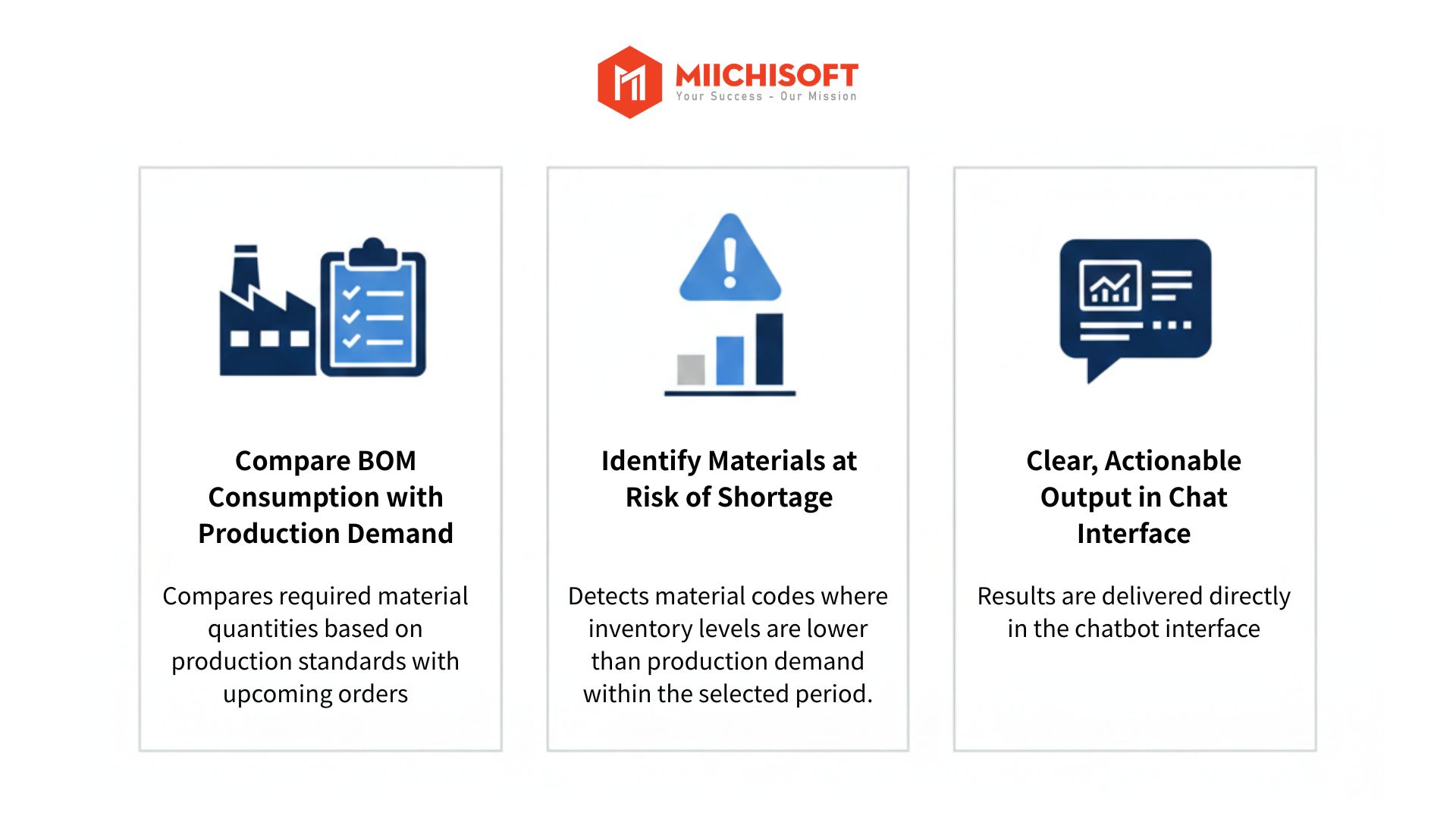
- Cross-reference material consumption standards with actual demand
Compare the quantity of materials required per production standard against the volume of orders scheduled for execution.
- Identify raw material items at risk of shortage
Automatically detect materials whose inventory levels fall below production demand for the period.
- Deliver results in a clear, digestible format
Answers are returned directly in the chatbot interface, replacing complex ERP data tables with straightforward summaries.
※ Other Dify cases: [Dify Case Study] Dify AI Contract Review Chatbot in 2 Minutes – Standardized to Internal Compliance Requirements
Dify chatbot implementation services by Miichisoft
In practice, an AI ERP Query Bot can reduce data retrieval time from several minutes to just a few seconds, enabling each department to make decisions based on real-time data instead of waiting for manual reports. To achieve these results, enterprises need a partner with deep ERP domain knowledge and proven experience in designing AI chatbot architectures.
*Learn more: 6 Criteria for Dify Implementation Vendor Selection you must know! [Free RFP Template]
With years of experience serving the Japanese market, Miichisoft positions itself as a trusted partner for consulting and implementing AI chatbots using the no-code/low-code Dify platform. Rather than taking a “build fast and move on” approach, we act as a long-term growth partner, helping enterprises define clear business objectives, design implementation roadmaps aligned with budget constraints, and scale chatbot capabilities over time.
Miichisoft’s key differentiation lies in its end-to-end approach: from use case consulting and chatbot architecture design (including RAG), to technical implementation, post-go-live support, and continuous optimization. We understand that successful Dify chatbot implementation requires not only technical expertise, but also a deep understanding of the client’s business operations.
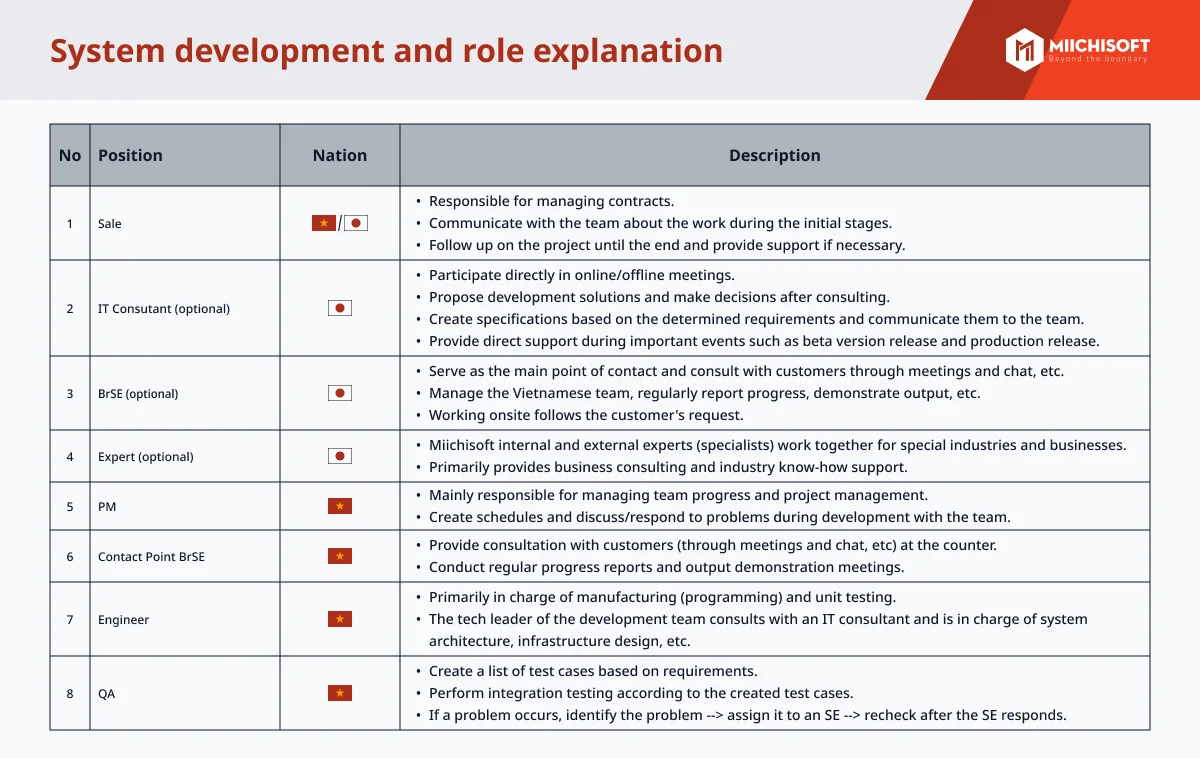
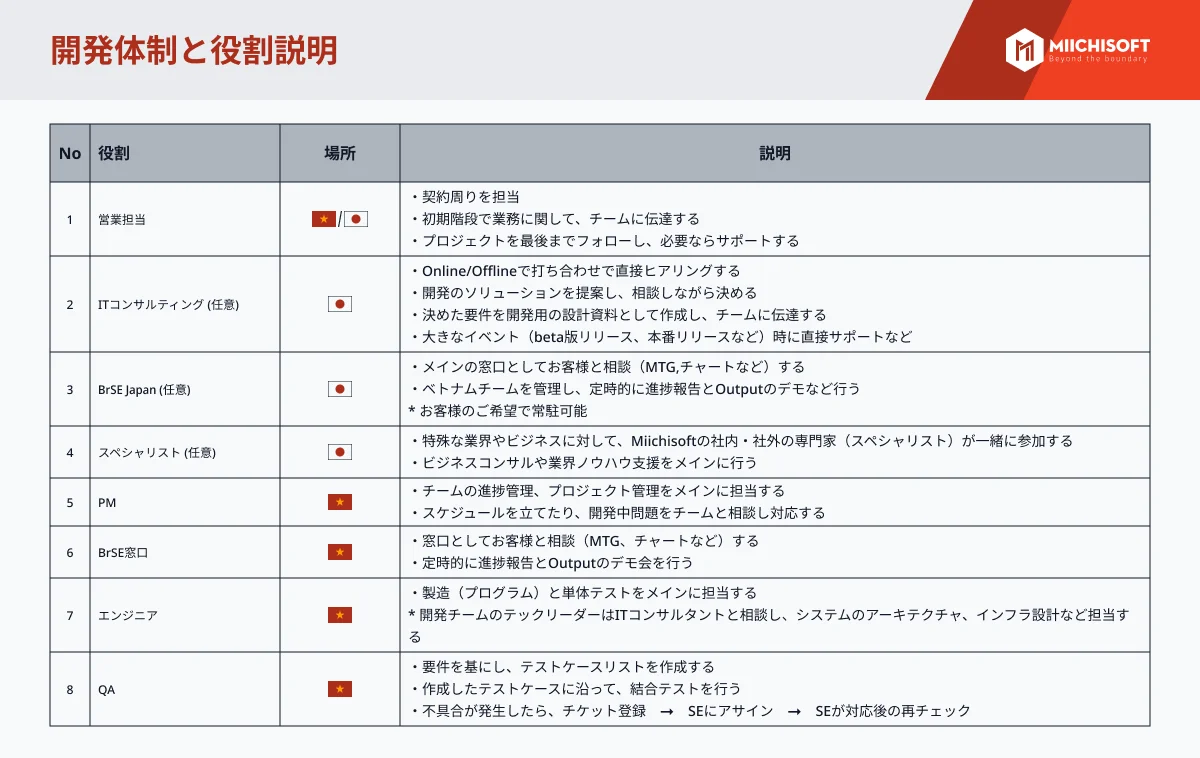
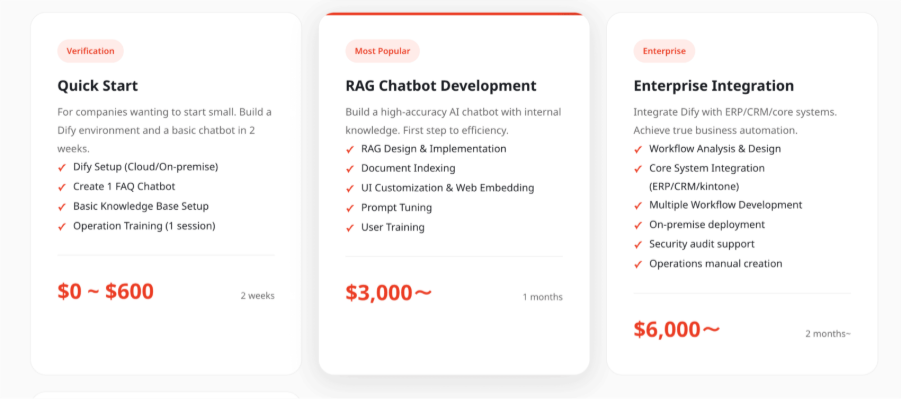
To support enterprises at different stages of adoption, Miichisoft offers flexible service packages tailored to each phase of chatbot implementation:
*Learn more: Dify Chatbot Pricing: Complete Guide to Deployment & Operating Costs
Conclusion
The AI ERP Query Bot is designed to address common operational challenges related to ERP data access. Acting as an intelligent middleware layer, the chatbot enables users to ask questions in natural language and receive direct answers from internal system data.
By eliminating manual navigation across ERP modules, enterprises can significantly reduce information retrieval time and improve overall data utilization efficiency.
For organizations seeking a practical and sustainable approach to unlocking the full value of their ERP data, Miichisoft is ready to support the entire journey from business process analysis and solution design to real-world implementation and ongoing operation.
Schedule a free 30-minute consultation to explore Dify case studies and discuss your use case: Book a session here.
FAQ
Q1: How long does it take to implement an AI-powered ERP query chatbot?
A1: A basic chatbot (pilot version) can be built in as little as two weeks. A full RAG-based system typically requires around one month, while enterprise-grade projects involving core system integrations usually take approximately three months.
For organizations looking to start with an optimized budget, Miichisoft offers the Dify Quick Start package, which enables enterprises to build a basic AI chatbot within two weeks to validate a specific business use case before scaling across the entire system.
Package details: Learn more here.
Q2: Can user query history be monitored and audited?
A2: Yes. Dify records of query logs to support internal governance, auditing, and user experience optimization. This capability is particularly important for enterprises with strict management, compliance, and data governance requirements.
Q3: Can the ERP query chatbot be expanded to support additional business functions after deployment?
A3: Yes. The solution is designed with a scalable architecture that allows for gradual expansion.
Enterprises can start with a specific use case – such as receivables management or inventory tracking and later add more ERP modules based on actual business needs, without rebuilding the system from scratch.