




Dify is becoming a popular choice for businesses looking to adopt AI-easy to deploy, flexible, and cost-effective. However, this very “ease of use” creates a new challenge: too many vendors are flooding the market, and not all of them can help you achieve real business results.
The reality shows that the massive wave of AI investment comes with an alarmingly high failure rate. A 2025 survey by S&P Global Market Intelligence of over 1,000 enterprises in North America and Europe found that 42% of companies have abandoned most of their AI initiatives, a sharp increase from 17% in 2024. On average, organizations scrap about 46% of their AI projects during the proof-of-concept stage before they even reach production.
The problem isn’t AI technology itself. The problem lies in how you choose your implementation partner.
Many businesses still select vendors based on a single criterion: “Can they build it?” But the more important question is: “Can they help us achieve results?”
This article will help you:
- Understand the 6 criteria to evaluate and select a true “partner committed to results”
- Get a ready-to-use RFP (Request for Proposal) template for your vendor selection process
1. “Does AI Really Deliver Results?”
If you’re asking this question, you’re not alone. And frankly, it’s a completely valid concern.
A 2025 “State of AI in Business” report by MIT and its partners reveals that only about 5% of GenAI pilot programs create measurable financial impact on P&L. This means the vast majority of AI/GenAI pilots today fail to deliver business value that matches expectations. (Fortune)
Many experts attribute the root cause not to AI technology itself, but to data quality, integration architecture, and how organizations define and prioritize use cases: fragmented and unstandardized data, legacy systems that are difficult to integrate, unclear business expectations, and poorly designed operational processes, ROI measurement, and risk governance.
This leads to an important conclusion: the success or failure of AI projects largely depends on the implementation approach and choosing the right partner.
Framework for Evaluating AI Value:
AI Value = (Cost Savings + Revenue Increase) − (Implementation Cost + Operating Cost)
This formula looks simple, but here’s the key point: A vendor who can calculate this equation WITH you BEFORE implementation is a vendor worth trusting.
A notable study from McKinsey (2025) shows that organizations achieving significant ROI from AI are twice as likely to redesign end-to-end workflows before selecting technology solutions. In other words, they start from the business problem, not from the technology.
2. 6 Criteria for Choosing a Dify Implementation Vendor
Overview Table
| # | Criteria | Core Question | 🚩 Red Flag |
| ① | ROI Design Capability | Can they calculate ROI with you before starting? | “Build first, measure later” |
| ② | Concrete Implementation Track Record | Do case studies have specific metrics or just impressive visuals? | Using NDA to refuse all details |
| ③ | PoC Support Capability | Can you start small to validate value? | Pushing large contracts from the start |
| ④ | Post-Implementation Support | Do they commit to continuous improvement? | “Delivery and done” attitude |
| ⑤ | Security and Compliance | Do they have clear, documented security policies? | No written policies |
| ⑥ | Integration Experience | Have they integrated with ERP, CRM, LINE? | Only standalone demos |
Detailed Criteria
Criterion 1: ROI Design and Impact Measurement Capability
Why it matters:
This is the #1 criterion for a simple reason: no matter how advanced the technology, it’s meaningless if not tied to business objectives. A Dify implementation vendor who is truly a “partner” won’t just ask “What do you want to build?” They’ll ask “What results do you want to achieve? How do we measure success?”
Questions to ask:
- Can you estimate ROI with us before implementation?
- What is your methodology for measuring effectiveness?
- Have you helped any customers achieve specific ROI? What were the numbers?
🚩 Red Flags:
- Avoiding discussions about KPIs
- Saying “Build first, measure effectiveness later”
Criterion 2: Concrete Implementation Track Record
Why it matters:
Many Dify implementation vendors showcase impressive client logos, but when you dig deeper, there are no concrete numbers. Logos don’t tell you anything-actual results matter.
A trustworthy vendor can share: the industry and scale of clients they’ve served, specific problems they solved, and measurable outcomes (hours saved, percentage improvement in efficiency).
Questions to ask:
- Do you have case studies similar to our situation?
- What specific results did those clients achieve?
🚩 Red Flags:
- Using NDA as an excuse to refuse sharing any details
- Vague case studies like “significantly improved efficiency”
Criterion 3: PoC and Small Start Support Capability
Why it matters:
AI implementation shouldn’t be a big gamble. The smart approach is “start small, prove value, then scale.”
Questions to ask:
- What is your minimum PoC package? Timeline and cost?
- How can we evaluate effectiveness after the PoC?
- If the PoC doesn’t meet expectations, what are the next steps?
🚩 Red Flags:
- Proposing large contracts from the start
- No PoC or trial packages available
- Showing reluctance when you suggest starting small
Criterion 4: Post-Implementation Support and Continuous Improvement
Why it matters:
This is something many businesses overlook: most of AI’s value comes from the phase AFTER go-live. A newly deployed chatbot won’t be perfect immediately-it needs additional training, fine-tuning based on real feedback, and continuous improvement.
Questions to ask:
- What is your post-implementation support structure?
- Do you have a regular improvement process? How frequent?
- What are the monthly support and maintenance costs?
🚩 Red Flags:
- “Delivery and done” attitude
- No post-implementation support packages
- Unclear or excessively high maintenance fees
Criterion 5: Security and Regulatory Compliance
Why it matters:
Especially for Japanese enterprises, security isn’t “nice to have”-it’s “must have.” A vendor lacking clear security policies is a risk you shouldn’t accept.
A trustworthy vendor will have ready documentation on data security policies, how customer data is processed and stored, and security certifications (if any).
Questions to ask:
- Please show us your security policy
- Where is our data stored? Who has access?
- What security certifications do you have? (ISO 27001, SOC 2, etc.)
🚩 Red Flags:
- No security policy documentation
- Vague answers about data handling
- No certifications or audit processes
Criterion 6: Integration Experience with Existing Systems
Why it matters:
AI operating in isolation won’t create real business impact. AI’s power lies in integrating into existing workflows-connecting with ERP, CRM, LINE, and internal systems.
Questions to ask:
- What systems have you integrated Dify with?
- Do you have case studies of ERP/CRM integration?
- What is your integration process? Estimated timeline?
🚩 Red Flags:
- Only standalone demos, no real integration cases
- No understanding of enterprise systems (ERP, CRM, etc.)
- Avoiding integration questions or saying “we’ll figure it out later”
3. Dify Implementation Vendor Comparison Scoring Matrix
To make your evaluation more objective, you can use the following scoring matrix to compare multiple Dify implementation vendors simultaneously.
How to use: Score each criterion from 1-5 (1 = Very Weak, 5 = Excellent)
| Criteria | Vendor A | Vendor B | Vendor C |
| ① ROI Design Capability | /5 | /5 | /5 |
| ② Concrete Implementation Track Record | /5 | /5 | /5 |
| ③ PoC Support Capability | /5 | /5 | /5 |
| ④ Post-Implementation Support | /5 | /5 | /5 |
| ⑤ Security and Compliance | /5 | /5 | /5 |
| ⑥ Integration Experience | /5 | /5 | /5 |
| TOTAL SCORE | /30 | /30 | /30 |
Evaluation Guide:
| Total Score | Recommendation |
| 25-30 points | Priority consideration |
| 18-24 points | Needs further verification |
| Below 17 points | Recommend passing |
📌 This scoring matrix is included in the RFP Template below.
4. Free RFP Template
To save you time in the Dify implementation vendor selection process, we’ve prepared a complete RFP (Request for Proposal) template
The RFP Template includes:
- Company introduction and project background sections
- Question list based on the 6 evaluation criteria
- Vendor comparison scoring sheet
- Proposed timeline template
Sample questions from the RFP:
“Please describe your specific methodology for measuring effectiveness at 3 months post-implementation and your improvement proposal process.”
“Please provide at least 2 case studies from similar industries with concrete, measurable results.”
📥 [DOWNLOAD FREE RFP TEMPLATE]
5. “Start Small First” – A Smart Choice
Comparing through RFPs is necessary, but the surest way to evaluate a vendor is to “actually experience working with them.”
Before committing to a large investment, there’s a way to start small and feel the results for yourself.
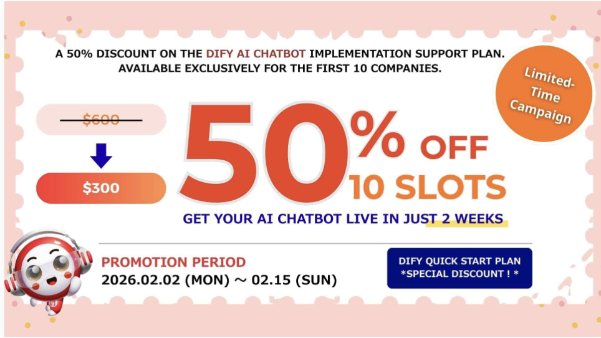
Dify Quick Start Package
| Item | Details |
| Duration | 2 weeks |
| Cost | |
| Condition | Limited to first 10 companies |
Package includes:
- Dify environment setup
- Working FAQ Chatbot creation
- Operations training for your team
- Roadmap proposal for next steps
The real value:
This isn’t just a service package-it’s a way for you to answer the question: “Is this Dify implementation vendor truly a partner committed to results?”
In 2 weeks, you’ll see how they work and communicate, their ability to understand and meet your requirements, the quality of actual deliverables, and their level of support and commitment.
💡 “Experience it yourself in 2 weeks to know if we’re truly a ‘partner committed to results.'”
REGISTER HERE: https://miichisoft.com/dify-quick-start-promotion/
6. Conclusion
For AI to truly deliver results, don’t choose a “vendor who can build”-choose a “partner committed to results.”
3 things to remember for choosing Dify implementation vendor
- Confirm ROI design capability first – If a vendor can’t discuss KPIs and how to measure effectiveness, that’s the biggest red flag.
- Use the 6 criteria to score and compare objectively – Don’t let subjective impressions or flashy sales pitches cloud your judgment.
- When in doubt, start small and evaluate through real experience – The best way to know if a vendor is trustworthy is to actually work with them.
You can start by downloading the RFP template to compare vendors, or register for the Quick Start package to experience it firsthand. Whichever you choose, contact us for additional consultation.
7. FAQ – Frequently Asked Questions About Choosing a Dify Implementation Vendor
Q1: How do I evaluate the real capability of a Dify implementation vendor?
The most effective way to choose a Dify implementation vendor is to use the 6 criteria: ROI design capability, implementation track record with specific metrics, PoC support capability, post-implementation support commitment, clear security policies, and integration experience with existing systems. A trustworthy vendor will proactively discuss KPIs and how to measure effectiveness from the very beginning.
Q2: How much does Dify implementation cost for enterprises?
Dify implementation costs depend on the scale and complexity of the project. Businesses can start with a PoC package to validate value before making a larger investment. The “start small, prove value, then scale” approach helps reduce risk and ensure ROI.
Q3: How long does it take Miichisoft to implement Dify for enterprises?
The basic Quick Start package (including environment setup, FAQ chatbot creation, and training) takes about 2 weeks. Full-scale projects with ERP/CRM integration can take 1-3 months depending on complexity. According to Gartner, it takes an average of 8 months to move an AI prototype to production-therefore, choosing the right experienced partner can significantly shorten this timeline.
Q4: What signs indicate an untrustworthy Dify vendor?
Red flags to watch for when choosing a Dify implementation vendor: avoiding discussions about ROI/KPIs, having only client logos without specific case studies, pushing large contracts from the start instead of proposing a PoC, a “delivery and done” attitude with no commitment to post-implementation support, and lacking clear security policy documentation.
Q5: Should I choose a domestic or offshore vendor for my Dify project?
This decision depends on many factors: budget, language/cultural requirements, and the level of support needed. Offshore vendors may have cost advantages, but you need to ensure they understand your market and regulations. Most importantly, evaluate them according to the 6 criteria in this article-actual capability matters more than geographic location.
![[Dify Case Study] Dify AI Contract Review Chatbot in 2 Minutes – Standardized to Internal Compliance Requirements](https://miichisoft.com/wp-content/uploads/2026/02/difyai-2-1.jpg)